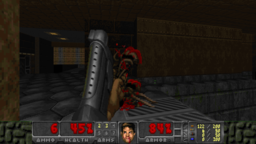
How it's built, patched and set up for its played test. The numbers are under Test runs.
dsda-doom 0.30.0 runs on its OpenGL renderer at about 56 frames a second with Freedoom’s data, with no stalls. Walnut’s patches fix the little-endian sound lumps, upload the indexed textures in a format the RSX has (stock GL mode left walls and sprites missing or black), and batch the GL draws.
dsda-doom 0.30.0 (the PrBoom+ successor, with the same GL renderer) plays Freedoom’s DEMO1 on its GL renderer at 55.9 steady fps with no stalls, after big-endian and GL fixes of ours. Its OpenGL played session (2026-10-25) had a 58 fps median and was smooth; the software launcher 44. What is left is the MIDI music, which still chops: FluidSynth’s voice DSP on the SPEs halved the underruns, but hundreds a minute remain.
Packages and settings
Our build of Debian’s dsda-doom (0.30.0+dfsg-1+ps3.N, packages/dsda-doom),
replacing Debian’s, with Debian’s freedoom 0.13.0 (/usr/share/games/doom/freedoom2.wad). The release candidate is ps3.361.
| Patch | What | Switch |
|---|---|---|
| 0001 | dsda-doom.wad’s DMX sound lumps read little-endian | |
| 0002 | GL renderer: indexed textures as GL_LUMINANCE_ALPHA. Stock GL mode uploads every indexed texture (walls, sprites, menus) as GL_RG, which nv30 lacks (no ARB_texture_rg): missing or black textures | |
| 0003 | the software renderer’s SDL buffer in the texture’s own format (the colours were wrong; the 960x540 frame was green-tinted through SDL’s GL renderer) | |
| 0004 | screenshots in RGB24 | |
| 0005 | batched GL draws: on llvmpipe the gl timedemo went from about 1960 to 390 GL calls and 205 to 44 draws a frame | DSDA_GL_BATCH, DSDA_GL_FLATS, DSDA_GL_HUD, DSDA_GL_VLIGHT, DSDA_GL_STATS |
| 0006 | DSDA_BENCH_LOOPS=N repeats the timedemo N times, each with its own “Timed …” line |
- Two menu entries of ours (desktop/launchers) replace Debian’s (diverted): “DSDA-Doom (OpenGL)” at 1920x1080 and “DSDA-Doom (software)” at 960x540 scaled (at 1920x1080 the PPE manages about 5 fps in software).
- Music is MIDI through SDL_mixer and our FluidSynth (
libfluidsynth32.6.1+dfsg-1+ps3.N, its voice DSP on the SPEs through libspeq,SPEQ_SYNTH=auto|spu|ppe|off; SPU-AUDIO.md).
How it performs
| Configuration | Steady fps | Gameplay stalls / 1% low / longest | Free RAM / VRAM | Batch |
|---|---|---|---|---|
gl (batching on) |
55.9 | 0.0 s / 40.3 / 34 ms | 43 / 65 MB | batch 2026-10-18-batch8 |
gloff (batching off, same boot) |
54.2 | 0.0 s / 36.4 / 68 ms | 44 / 65 MB | batch 2026-10-18-batch8 |
| software, profiled | 40.3 | 0.0 s / 21.8 / 97 ms | 45 / 26 MB | batch 2026-10-18-mesa-407-switches |
gl, profiled, SSD root |
55.9 | 0.0 s / 39.7 / 42 ms | 43 / 66 MB | batch 2026-10-19-ssdroot2-gameplay-profiles |
The batching gave +3% and better lows (CPU 118 against 161 s). The gameplay profile
(batch 2026-10-19-ssdroot2-gameplay-profiles): Mesa 22% of the samples, the game 20.5%, the music
about 31% on the audio thread (FluidSynth 14.2%, libspeq 11.9%: speq_synth_add_v2 7.4%,
speq_synth_render_v2 2.0%; ALSA 3.4%), kernel 12.7%, ps3rsx 3.3%, Xorg 8.7% of the game’s; 2793
underruns in the run. The music is
the largest share of the seven profiles
(HOTPATHS.md).
The benchmark (recipe): -timedemo demo1 (Freedoom’s own DEMO1 lump, 2664
gametics, 76 s at 35 Hz), 6 passes (DSDA_BENCH_LOOPS=6, PASSES=1). The load ends at Playing demo:
(the recipe’s LOAD_MARK; 0.30 never prints the R_Init lines on the PS3), where the window, perf and the
memory snapshots start. Base is the software renderer at 960x540 scaled by SDL;
the bench row of the suite is gl. Freedoom 0.13’s own demos desync (freedoom issue #1532), which
doesn’t matter for a timedemo: the same tics play every run. Variants include play (the demo at normal
speed with GL, 60 s, for the sound), playnomusic, tuned (OPL music, 48 kHz, a 2048 buffer, 60 fps
cap), playopl, playspu, playppe, playoff, the batching switches and owncfg (base on a config
of the run’s own, -config in the run directory: dsda-doom’s defaults, the player’s file untouched).
Known problems
- The MIDI music chops: about 465 sound underruns a minute with the synthesizer on the SPEs; the OpenGL session counted 7.5 audible dropouts a minute, the software one 35.9 (the CPU renders there). The decision on the default (FluidSynth on the SPEs, OPL, or no music) waits on the cause (the investigation).
Investigations
Research
What the surveys and plans said about it, newest first; each line names its source, the section and the date.
- 2026-10-16, game-candidates.md, “The recommended suite and why”: PrBoom+ GL (on the user’s list) is covered by dsda-doom, its successor with the same GL renderer, packaged for ppc64.
- 2026-10-15, the user’s first wish list (backlog.txt, commit 7d58e3d), “2. GPU driver and game support”: “PrBoom+, with its GL renderer” a stretch goal: easy, a light test of the 2D/texture paths more than real 3D.
Build
| Packages | dsda-doom, freedoom |
|---|---|
| Suite | in the game suite (known to run with its sound), free data |
| Game data | comes with the packages |
| Diverted | /usr/share/applications/dsda-doom.desktop (our launchers stand for them) |
Our source packages
- dsda-doom source
7 patches
- rdatawad: write the DMX format field little-endian
- GL: indexed textures as GL_LUMINANCE_ALPHA without ARB_texture_rg
- SDL video: the 32-bit buffer in the texture's pixel format
- Screenshots: declare the grabbed pixels as SDL_PIXELFORMAT_RGB24
- GL: fewer, larger draws (batched walls, flats, sprites and HUD patches)
- timedemo: DSDA_BENCH_LOOPS=N repeats the demo N times, one Timed line per pass
- OPL player: no GENMIDI lump means no OPL music, not a fatal error
Played test
What a played session sets up (rating/test.toml); the medal comes from these sessions only.
| Process | dsda-doom |
|---|---|
| Set aside | ~/.local/share/dsda-doom, ~/.dsda-doom (the game starts on fresh defaults) |
| Load ends at | ^(R_Init|S_Init|HU_Init|ST_Init|Playing demo:) |