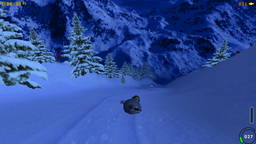
How it's built, patched and set up for its played test. The numbers are under Test runs.
Extreme Tux Racer 0.8.4 runs with the right picture and sound at about 59 frames a second. Walnut’s six patches send fewer, larger OpenGL draws (terrain from buffers, trees and snow in one draw per texture), taking a frame from 19,400 GL calls to 850.
Extreme Tux Racer 0.8.4 runs with the right picture and sound at about 59 fps in the benchmark, not a vsync cap (59 uncapped too), after our patches cut a frame from 19,400 GL calls to 850. Its played session (2026-10-24, with the controller patch) had a 58 fps median, the controller fully usable, and 608 sound xruns the player didn’t hear, which the new SFML audio period is meant to remove.
Packages and patches
extremetuxracer, extremetuxracer-data (0.8.4-2+ps3.N, packages/etr), replacing
Debian’s. SFML 3.1 already has its big-endian Ogg fix.
- 0001-0006
send fewer, larger GL submissions, each behind a switch (
ETR_GL=0turns all off): a bind cache and the HUD numbers (ETR_GL_BIND,ETR_GL_HUD), the terrain from buffer objects in one quadtree walk (ETR_GL_TERRAIN), Tux’s spheres from cached vertex arrays and the shadow in one draw (ETR_GL_TUX,ETR_GL_SHADOW), track marks as arrays of what the camera sees (ETR_GL_TRACKS), trees and items in one draw per texture (ETR_GL_TREES,ETR_GL_TREES_GROUP), snow spray, falling snow and curtains in one draw (ETR_GL_SNOW,ETR_GL_PARTICLES). A frame went from 19,400 GL calls and 697 draws to 850 and 72 (the investigation). - 0007 and
0008, game controllers: SFML 3
reads
/dev/input/js*, so a button is the joydev index (DualShock 3 through hid-sony: 0 Cross, 1 Circle, 2 Triangle, 3 Square, 4 L1, 5 R1, 6 L2, 7 R2, 8 Select, 9 Start, 13-16 the d-pad; L2/R2 are buttons, not axes). In menus the d-pad and left stick are the arrow keys, Cross and Start Enter, Circle Escape; in a race the left stick (analog) or d-pad steer, R2/R1 paddle, L2/L1 brake, Cross jumps (hold to charge), Square tricks, Triangle changes the view, Select pauses, Start opens the race’s menu. The keys keep working and nothing is written to the options file; the scheme is on the Help screen in a second column. libsfml(packages/patched/audio/libsfml/,3.1.0+dfsg-4+ps3.N): SFML 3.1 (miniaudio) opened the ALSA device with a 64-frame period and 3 periods, a 4 ms buffer, which ETR can’t change; ours opens it with a 1024-frame period (the investigation).
How it performs
- Bench (batch 2026-10-18-batch17): 59 steady, 2.9 s of stalls (11 frames over 100 ms), 1% low 27.3, longest 483 ms, 29 MB free, 58 MB of VRAM, no underruns; the window holds the game-over screen and a reload. Picture and sound right.
- Its CPU outside Mesa is mostly freetype and harfbuzz (29% of the samples) and SFML audio.
- Its memory grows (MEMORY.md, the
MEM=1batch of 2026-10-18 on Mesa ps3.299): over a 117 s window malloc’s used memory went 17.5 to 18.5 to 19.9 MB (+2.4 MB) and its GART 8.8 to 12.8 to 16.8 MB (161 to 163 handles), two new buffers of about 4 MB, one a minute. The candidate is the track marks in the snow, a growing list drawn through our stream buffers; only a longer run tells a cap from a leak (the game’s todo.toml; the long-session soak).
The benchmark (recipe): ETR has no demo mode, so the user’s race was recorded as
keyboard events (evemu-record, variant record) and is replayed into a virtual keyboard from when ETR’s
window appears. assets/etr-race.evemu: Practice, one course, 69 s, the menus up to 24.7 s; the race is
raced again after the game-over screen from ETR_LOOP_FROM up to ETR_LOOPS times. fps from the HUD
window (WINDOW_STOP=1). ETR’s physics take the frame time as their step and the inputs replay at
wall-clock times, so at another frame rate Tux’s line can drift from the recorded one, more in later
races.
Investigations
- 2026-10-17 game-side batching: 52 to 59 fps, the CPU 83.6 to 53 s.
- 2026-10-24 the 4 ms sound buffer.
Research
What the surveys and plans said about it, newest first; each line names its source, the section and the date.
- 2026-10-15, the user’s first wish list (backlog.txt, commit 7d58e3d), “2. GPU driver and game support”: a strong candidate: GL 1.x and simple, a nice controller game.
Build
| Packages | extremetuxracer, extremetuxracer-data |
|---|---|
| Suite | in the game suite (known to run with its sound), free data |
| Game data | comes with the packages |
Our source packages
- etr source
8 patches
- ETR_GL switches, no repeated glBindTexture, the HUD numbers in one draw
- terrain from buffer objects, one quadtree walk (ETR_GL_TERRAIN)
- Tux: spheres from cached vertex arrays, shadow in one draw (ETR_GL_TUX, ETR_GL_SHADOW)
- track marks as arrays, only what the camera sees (ETR_GL_TRACKS)
- trees and items: one draw for each texture (ETR_GL_TREES)
- snow spray, falling snow and snow curtains in one draw each (ETR_GL_PARTICLES, ETR_GL_SNOW)
- Game controllers: menus and a fixed race scheme next to the keyboard
- Game controllers: Start opens the race menu (Escape), Select pauses
Played test
What a played session sets up (rating/test.toml); the medal comes from these sessions only.
| Process | etr |
|---|---|
| Set aside | ~/.etr, ~/.config/etr (the game starts on fresh defaults) |
| Command | /usr/games/etr |