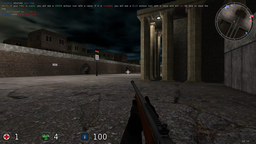
How it's built, patched and set up for its played test; it runs on the Cube 2 engine. The numbers are under Test runs.
Sauerbraten is the original game of the Cube 2 engine: the 2020 Edition release with its maps, models, sounds and
music. The engine is free (zlib licence) and is what Walnut’s cube2 package builds, with the same patches as
BananaBread, which runs on the same engine with different content: textures are compressed when they load, models
are skinned on the CPU (the RSX has no indirect constant addressing) and fewer GL calls are sent. The game’s data
has mixed licences, much of it Creative Commons non-commercial, so Walnut offers it only in its licensed repository
(sauerbraten-data); otherwise you unpack the data and packages folders of the
release from sauerbraten.org into /usr/share/games/sauerbraten (the Guides). The menu entry starts it fullscreen at the desktop’s resolution and keeps its settings
in ~/.sauerbraten.
The real game: Sauerbraten’s 2020 Edition release with its maps, models, sounds and music, on the same
Cube 2 engine build that runs BananaBread.
Debian’s cube2 is Sauerbraten’s own engine source, so no second engine package was made (building the
release’s source again would give the same program without the patches); what was missing was the
launcher and the data. It plays right, but its big maps fill the 250 MB of VRAM, and both played sessions
ended in a crash in Mesa when that happened. Those two crashes are fixed (Mesa 0046, then 0047 and 0048);
a session with all three is still to be played.
Packages and settings
| Package | Suite | What |
|---|---|---|
sauerbraten-walnut (packages/sauerbraten-walnut) |
public (testing, stable; CI builds it, 0.N; up to 0.874 it was named sauerbraten, Debian’s non-free package’s name, and now Conflicts/Replaces it) |
/usr/games/sauerbraten, the menu entry (Name Sauerbraten), an icon. Depends on cube2, Suggests sauerbraten-data |
sauerbraten-data (licensed/sauerbraten-data) |
the licensed suite only, built locally (0.0.20201229-1+ps3.N, about 980 MB) |
the release’s data/ and packages/ whole, in /usr/share/games/sauerbraten. Depends on sauerbraten, so installing the data installs the game. Install by name (no [data_setup] yet) |
- The launcher runs
cube2_client -q$HOME/.sauerbraten -k/usr/share/sauerbraten/walnut -k/usr/share/games/sauerbraten -t1: fullscreen at the desktop’s resolution (the engine sizes its window from the desktop whenscr_w/scr_hare unset; Debian’s build defaults to a window, hence-t1), settings apart from BananaBread’s~/.cube2, no user file written.SAUERBRATEN_WINDOWED=1starts in a window. - Walnut’s defaults: the first package directory holds only
data/defaults.cfg(files/walnut), which the engine runs only while~/.sauerbraten/config.cfgdoes not exist. It runs the release’s own defaults.cfg, then setstexcompress 512: of the release’s 2155 world texture files, the 512-pixel ones are 772 files and 76% of the bytes, whichtexcompress 1024leaves plain and 512 stores in an eighth (DXT1) or a quarter (DXT5). The game saves it into config.cfg at the first quit and the player’s settings rule from then on (/texcompress 1024restores the engine’s value). Unmeasured on the real game yet: the next session’s VRAM column decides whether it stays. sauerbraten-datais a second package beside BananaBread’ssauerbraten-nonfree-data: the real game needs the maps, textures and music too, in its own directory so neither game sees the other’s files. The orig tarball is made from the pinned release archive by itssauerbraten-full-data.sh(make sauerbraten-data-src), never committed; mixed, partly non-commercial licences, so it is licensed (no CI workflow).- Endianness: nothing to fix. The engine already runs big-endian (the maps read through
lilswap), and the release’s maps and models use the same formats. - All of the engine’s patches apply (0001-0010; 0011
vanormalshortbuilt in and off).
How it performs
Two played sessions, both crashes, both on the online and bot maps that fill the VRAM:
- 2026-10-24 (an online insta-CTF match on eternal_valley, then berlin_wall): 54 fps median, 14.7 s of
stutter a minute, a segfault after 202 s of play in
nv30_query_object_del: nv30’s 124 report slots were taken back from queries that still pointed at them (the engine ends up to 2048 occlusion queries a frame and reads them a frame later), which also gave queries each other’s results (geometry popping, the user’s “a bit glitchy”). Fixed by Mesa 0046. - 2026-10-25 (bots, about 6 minutes, Mesa ps3.819 with 0046): 38 fps median; no query crash, but a write
through NULL in libc at 400 s, after three
out of GART for a 4096 KiB BOlines: Mesa’sst_setup_current()copied the current vertex attributes into au_upload_alloc()result it never checked. Fixed by Mesa 0047 and 0048 (Mesa ps3.827).
What the sessions measured about memory: cube2_client held 180 MB of VRAM on eternal_valley and 210 MB
after the map change (probably the previous map’s textures still loaded), Xorg 27-35 MB: the whole
250 MB. The VRAM swap gave all 96 of its chunks back as designed, so its pages went to the disk;
MemAvailable 22-45 MB. The 30 MB of GPU-only VRAM held 132 KiB: on the PS3 every nv30 texture asks for
CPU-visible VRAM. The second session ran with the player’s own config.cfg, so texcompress 512 did not
apply. The crash analysis is in the investigation.
The benchmark (recipe, variants complex, metl3, lean, gpuskel) was called
sauerbraten-edition before 2026-10-26 (run.sh still takes the old name); the played test
(rating/test.toml) is the launcher alone, its play_mark the read map line. Its PC
reference (tools/play-pc.sh) installs the entry’s packages from Debian, which has no sauerbraten: use
PC=0 play-test.sh start sauerbraten until the PC image gets our two debs.
Known problems
- VRAM runs full on the big maps. New installs compress more textures (
texcompress 512); an existing config keeps its own setting. A launcher-environment alternative that works with any config is Mesa’sNV30_FORCE_DXT=opaque(BananaBread: -40% VRAM, softer textures, batch 2026-10-19-ssdroot2-force-dxt): the user agreed to it as the launcher’s default on 2026-10-26; not set yet, it comes with its own session after the crash fixes’ (todo.toml). out of VRAM for a 8100 KiB BObursts (135 failures each) come 1.4-1.5 s after each of the bench’sxwdscreenshots when the VRAM is full: X’s GetImage answers in bands of 8 lines (135 = 1080 / 8) and each band asks for a screen-sized buffer (most likely glamor’s readback copy), which fails and falls back. They are Xorg’s, only while a screenshot of a full VRAM is taken, and not the game’s.- Not done: render targets and depth buffers in the GPU-only 30 MB. nv30 maps every miptree CPU-visible
because
nv30_transfer_rect_cpumay map it; a buffer never read back by the CPU could go there (8 MB each at 1080p), but whether every transfer path avoids the CPU map is unproven.
Investigations
- 2026-10-24 the online crashes: the query slots (Mesa 0046) and the NULL upload buffer after GART ran out (Mesa 0047, 0048).
- The engine’s (Cube 2).
Research
What the surveys and plans said about it, newest first; each line names its source, the section and the date.
- 2026-10-15, the user’s first wish list (backlog.txt, commit 7d58e3d), “2. GPU driver and game support”: “Sauerbraten (Cube 2)” a strong candidate: a modest engine with a built-in map editor; a step up in GPU load.
Build
| Packages | sauerbraten-walnut, cube2 |
|---|---|
| Suite | not in the game suite yet |
| Game data | the player supplies it (see the game's page); plays with sauerbraten-data |
| Licensed data | sauerbraten-data (built from the player's own copy, never public) |
| Menu entries | sauerbraten.desktop |
Our source packages
- sauerbraten-walnut source no patches on top of the upstream source
- cube2 source
11 patches
- Compress textures at upload on Mesa too (texcompress)
- CPU skinning by default, and no GPU skinning shaders without gpuskel
- Build only the world shader variants that can be drawn
- Sky boxes and cube maps from their .dds, and one side at a time
- Free the lightmaps' CPU copies once uploaded
- CPU skinning through libspeq on the PS3's SPEs
- Do not send shader uniforms whose value did not change (gluniformcache)
- Bind the textures of a batch in one go (glbatchtmu)
- Upload only the particles that exist (glpartvbo)
- Water occlusion queries without waiting for the GPU (oqwaterlag)
- World normals and tangents as 16-bit signed normalized (vanormalshort)
Played test
What a played session sets up (rating/test.toml); the medal comes from these sessions only.
| Process | cube2_client |
|---|---|
| Set aside | ~/.sauerbraten (the game starts on fresh defaults) |
| Command | /usr/games/sauerbraten |
| Play starts at | ^read map |
| Load ends at | ^read map |