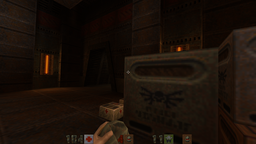
Played sessions
Testing is done with Walnut's rating tool (walnut-rate, on the console): how ratings are made and submitted.
Builds:
Walnut 0.1,
yamagi-quake2 8.70+dfsg-1+ps3.839
The platform builds under it (3)
| Linux kernel | 6.12.111+ps3.786 Walnut's build |
|---|---|
| Mesa | 26.2.4-1+ps3.827 Walnut's build |
| ps3rsx | 0.788+k6.12.111+ps3.786 Walnut's build |
| Date | Launcher | Rules | Play | Ended | Picture | |
|---|---|---|---|---|---|---|
| 2026-10-26 | Quake II (demo) | 2.3 | 8 min | quit | minor | Details |
Download all sessions as CSV (one row per session, the aspects as columns)
Rating history
The rating on each version it was tested on, newest first: each row is rated from that version's sessions alone, under the newest rules those sessions have the data for.
| Version | Tested | Medal | Rules | Frame rate | Smoothness | Sound | Picture | Stability | Controls | Display | Features | Load | Play |
|---|---|---|---|---|---|---|---|---|---|---|---|---|---|
| Walnut 0.1 yamagi-quake2 8.70+dfsg-1 |
2026-10-26 | Gold · 88 | 2.3 | 83 | 85 | 100 | 75 | 90 | 100 | 85 | 100 | 94 | 0.1 h 1 test |
Scripted benchmarks
Not rated: tests of driver and game changes. A script plays the same scene on the PS3 again and again (the desktop stopped, vsync off) to compare two builds of the game or of the graphics driver. The numbers say which build is faster; they never feed the medal.
How the script plays it: Yamagi Quake II 8.70 with the Quake II demo data: timedemo of the demo pak's only demo, q2demo1.dm2, on the gl1 renderer, fullscreen 1920x1080, vsync off.
The recipe's full description
Yamagi Quake II 8.70 (our build of Debian's yquake2, gamedb/games/yquake2/packages/yquake2/) with the Quake II demo data (quake2-demo-data from make game-data: /usr/share/games/quake2-demo/baseq2/pak0.pak): timedemo of the demo pak's only demo, q2demo1.dm2, on the gl1 renderer (GL 1.4 fixed function; gl3 needs GL 3), fullscreen 1920x1080, vsync off (a timedemo isn't otherwise capped). It returns to the console after the demo: stopped at the result line. The engine is run directly (Debian's quake2 wrapper package is contrib and not ours); the config is ~/.local/share/YamagiQ2/baseq2/config.cfg (8.70 is built with XDG support: "Using '<home>/.local/share/YamagiQ2/baseq2' for writing", session of 2026-10-26); builds without it used ~/.yq2. Steady state: the timedemo repeated in one session (PASSES=1: passes starting 54 s or more after the first counted until ~120 s, then the game is stopped). At a demo's end the server runs the nextserver cvar, which demomap fills from nextdemo; autoexec.cfg's alias `bench` sets nextdemo again, disconnects (CL_Disconnect prints the pass's line; a plain chained demomap would reconnect and clear the counters without a line, cl_parse.c CL_ClearState) and starts the demo cold again. Each pass prints "ERROR: Disconnected from server" too. fps= is the first pass's (as before).
The recipe today runs it at the game's own resolution, with vblank_mode=0 (vsync off). Older batches ran the recipe as it was then: their titles and observations say what changed (a new game build, a driver change).
13 variants of the recipe
base | the recipe as it is, without a variant |
|---|---|
sdlsound | Yamagi's SDL sound backend instead of OpenAL (OpenAL gave white noise on the PS3: 16-bit samples with their bytes swapped somewhere on the way, big-endian) |
kissbig | the KISS PRNG's lag table (our yquake2 0002, YQ2_KISS_QSIZE): the package's default is 4096 entries, 32 KiB each (docs/MEMORY.md; measured on the PS3: 70 MB less RAM, gameplay stalls 22.6 -> 0.05 s). The old table was 16 MiB in the client and 16 MiB in game.so, all written at start (32 MB of the game's 77 MB resident): variant kissbig restores it (the base is the small table). Client-side randomness (particles) differs from the old sequence, the demo doesn't |
kiss4k stands for the game | - |
allog | - |
b16 | - |
f44 | - |
b16f44 | - |
p1024 | - |
alnull | - |
f32 | - |
lin | - |
nosound | - |
One table, a header row per batch (what it tested and what came out). Conditions: what a variant adds to the recipe (its environment switches) and what ran alongside (the stall recorder, a profiler); a column appears only when this game has a value in it. Rows marked invalid or not comparable say why.
What the run length means
"warm-up + 120 s" is a steady-state run, which leaves out a 60 s warm-up and measures 120 s or more; "whole run" counted everything from the start, the way runs before 2026-10-17 did.
| Variant | Conditions | Steady fps in the window |
1% low fps |
Stalls frames over 100 ms |
fps whole run |
Build | Run length | ram free MiB | vram MiB | stall play s seconds | longest play ms ms | sound faults per min faults a minute | cpu seconds | underruns underruns | longest ms ms |
Note |
|---|---|---|---|---|---|---|---|---|---|---|---|---|---|---|---|---|
Suite summary
2026-10-20 · suite-summary-2026-10
Tested: Not a test run: the suite's 13 benchmarked games (15 rows, with OpenArena's two renderers and OpenTTD's two blitters) gathered with their known numbers as of October 2026, each value naming the batch or document it came from. Result: It is the calibration of the rating formula (rules 1): the scale was tried on these numbers before any game was rated, and the GameDB calibration table is generated from it. Benchmarks never give a medal; medals come from played sessions only. | ||||||||||||||||
| Yamagi Quake II | YQ2_KISS_QSIZE=4096 | 68.7 | 31.1 | - | - | - | warm-up + 120 s | 46 | 48 | 0.1 | 91 | 0 | - | - | - | right, right (our fix) |
RT mixer: RTPRIO=10 against RTPRIO=0 (OpenAL's mixer on SCHED_RR) on OpenArena, Yamagi Quake II and Luanti base x3 (kernel .874)
2026-10-28 · 2026-10-28-rtprio-openal
Tested: Whether letting OpenAL's mixer thread run at real-time priority (SCHED_RR, allowed by a priority limit of 10) prevents sound dropouts in OpenArena, Yamagi Quake II and Luanti, three rounds. Result: No gain: there were no audible dropouts with or without it, and it cost a little frame rate. Not shipped. What we saw18 runs, rounds alternating the order, none interfered. Every run fullscreen at 1920x1080, with a screenshot 40 s after the load.
| ||||||||||||||||
base |
real-time priority 0 | 86.8 | 44.5 | 15 | 85.4 | - | warm-up + 120 s | - | - | 3.8 | 301.9 | - | 172.9 | 0 | 301.9 | |
base |
real-time priority 10 | 86.3 | 44.2 | 15 | 84.9 | - | warm-up + 120 s | - | - | 3.9 | 320.1 | - | 172.8 | 0 | 320.1 | |
Mesa ps3.407 NV30_TRANSLATE_LUT, yquake2 ps3.408 kiss4k, luanti ps3.405 trim16 (all with WAKER kick)
2026-10-18 · 2026-10-18-mesa-407-lut
Tested: Three changes: Mesa ps3.407's lookup table for 8-bit vertex attributes on BananaBread, Yamagi Quake II's memory cut (kiss4k) and Luanti's trim16 setting. Result: The lookup table speeds BananaBread up by 53%, and Yamagi's memory cut ends its stalls (22.6 s to 0.05 s). Luanti's trim16 gave no gain and more stalls, so it was rejected. What we saw
| ||||||||||||||||
base |
waker kick at 10 ms | 65.7 | 20.1 | 33.5 | 60.0 | Mesa ps3.407 | warm-up + 120 s | 12.2 | 48.2 | 22.6 | 4508.5 | - | 127.2 | 0.0 | 4508.5 | |
kiss4k |
YQ2_KISS_QSIZE=4096 waker kick at 10 ms |
68.7 | 31.1 | 0.5 | 64.7 | Mesa ps3.407 | warm-up + 120 s | 46.4 | 48.2 | 0.1 | 91.1 | - | 145.6 | 0.0 | 91.1 | |
Mesa ps3.262 runs with perf recording (audio profiling)
2026-10-17 · 2026-10-17-mesa-262-perf
Tested: Plain-named runs made while the audio profiling was going on: dsda-doom's music, OpenArena and Yamagi Quake II on Mesa ps3.262. Result: Not valid for comparison: perf was recording during these runs, which explains the slow OpenArena and Yamagi numbers. They say nothing about a change in Mesa ps3.262. What we saw
not comparable runs with perf recording (audio profiling), slower than plain runs. | ||||||||||||||||
basenot comparable |
the recipe as it is | - | - | - | 55.2 | Mesa ps3.262 | whole run | 27.0 | 48.2 | - | - | - | 16.9 | 20 | - | |
Mesa ps3.262 OpenAL log variants (allog; perf recording)
2026-10-17 · 2026-10-17-mesa-262-allog
Tested: How much of the CPU OpenAL's sound mixing takes in four games, profiled with perf, to see whether moving the mixer to the SPUs would pay off. Result: OpenAL itself is 3.7-4.7% of the game's CPU samples, under the 6% bar set for an SPU mixer. The frame rates are slowed by the profiler and are not for comparison. What we saw
not comparable OpenAL logging runs with perf recording, slower than plain runs. | ||||||||||||||||
allognot comparable |
the recipe as it is | - | - | - | 32.1 | Mesa ps3.262 | whole run | 31.7 | 48.2 | - | - | - | 16.5 | 14 | - | |
Mesa ps3.262 + ps3rsx 0.249
2026-10-17 · 2026-10-17-mesa-262
Tested: Mesa ps3.262 (patches 0019 to 0025: fewer words sent to the GPU per draw) across the suite, against ps3.246. Result: Big gains in several games: OpenArena +23%, Yamagi +24%, X-Moto +21%, Extreme Tux Racer and dsda-doom +15%. Armagetron fell from 60 to 51 fps, which the next batches traced. Single runs; BananaBread's drop is a memory stall, not a driver number. What we saw
| ||||||||||||||||
base |
the recipe as it is | - | - | - | 63.9 | Mesa ps3.262, ps3rsx 0.249 | whole run | 37.4 | 48.2 | - | - | - | 14.9 | 19 | - | |
Mesa ps3.246 + ps3rsx 0.249
2026-10-17 · 2026-10-17-mesa-246-ps3rsx-249
Tested: The first full suite round after the reboot into ps3rsx 0.249, one run per game, as a baseline. Result: Every game ran with the right picture. The sound was right except in dsda-doom (MIDI music), BananaBread and OpenTTD. Single runs, so differences of a few fps are noise. What we saw
| ||||||||||||||||
base |
the recipe as it is | - | - | - | 51.4 | Mesa ps3.246, ps3rsx 0.249 | whole run | 31.0 | 48.2 | - | - | - | 15.7 | 15 | - | |
Yamagi Quake II sample byte-swap fix (yquake2 +ps3.240)
2026-10-16 · 2026-10-16-yquake2-byteswap
Tested: Our yquake2 +ps3.240, which swaps 16-bit sound samples to the machine's byte order on load, against the white noise found before. Result: Fixed: sound right through OpenAL (the user confirmed), picture right, 56.1 fps, 7 underruns. Single run. What we saw
| ||||||||||||||||
base |
the recipe as it is | - | - | - | 56.1 | - | whole run | 36.4 | 48.2 | - | - | - | 15.7 | 7 | - | |
Yamagi Quake II OpenAL white noise (yquake2 +ps3.229; Mesa ps3.225)
2026-10-16 · 2026-10-16-yquake2-white-noise
Tested: Yamagi Quake II as our package, with its OpenAL sound against its SDL sound backend, to find where its white-noise sound comes from. Result: The noise is the OpenAL path, not the hardware: with SDL sound the audio is right. The OpenAL backend handed little-endian samples to OpenAL on this big-endian machine; fixed in yquake2 +ps3.240. What we saw
| ||||||||||||||||
base |
the recipe as it is | - | - | - | 51.1 | Mesa ps3.225 | whole run | 42.5 | 48.2 | - | - | - | 16.7 | - | - | |
sdlsound |
the recipe as it is | - | - | - | 58.4 | Mesa ps3.225 | whole run | 38.0 | 48.2 | - | - | - | 16.5 | 11 | - | |