How it's built, patched and set up for its played test. The numbers are under Test runs.
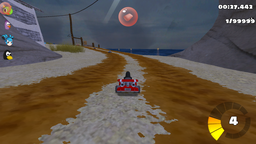
SuperTuxKart 1.5 runs on its legacy OpenGL 2.1 renderer with Walnut’s big-endian fixes: without them the game quits while loading its track models. The tracks and karts draw correctly. It is the heaviest game on the list: at the lean settings it races at 19 to 22 frames a second.
SuperTuxKart 1.5 runs on its legacy GL 2.1 renderer with our big-endian fixes; without them the game quits
while loading its track models. It is the heaviest game we play: at the lean settings, now the
package’s default for a fresh configuration, it races at 19-22 fps by the Gallium HUD in the benchmark,
and its played session on Mesa ps3.850 (2026-10-26) had a 24 fps median over five tracks with no crash
and no glitches. Light tracks play well, heavy ones (Ravenbridge Mansion) are slow, and a track’s load
takes about 20-30 s.
Packages and patches
supertuxkart, supertuxkart-data (1.5-2+ps3.N, packages/supertuxkart),
replacing Debian’s. supertuxkart-data is Debian’s data, rebuilt because supertuxkart needs it at its
own version. 839 MB with the data (752 MB of it data), so it deploys by name and is in no suite.
| Patch | What |
|---|---|
| 0001 | the .spm mesh and armature loader byte-swaps the little-endian data instead of refusing to run (upstream #5578 was closed as not planned); all 1268 .spm files parse identically on amd64 and ppc64 |
| 0002 | textures and vertex colours in the right channel order on the OpenGL driver |
| 0003 | legacy renderer: no crash when render-to-texture fails, a power-of-two (512x512) minimap render target |
| 0004 | texture compression reaches the legacy renderer: opaque power-of-two textures as DXT1, compressed by Mesa at upload |
| 0005 | STK_PROFILE_WARMUP=S: profile mode restarts its frame count and clock once the race passes S seconds and ends the race at S + the profile time |
| 0006 | defaults of a fresh configuration (a key already in config.xml keeps its value): the lean graphics (HD textures off, important particles only, drivers not animated, no minimap), texture compression on, the old-driver popup off, fullscreen at the desktop’s resolution (real_width/real_height 0, resolved in IrrDriver::initDevice) |
| 0007 | game controllers like a console game: a fixed scheme as the default bindings of any pad with the usual buttons, a second binding per action, a hot-plug scan |
Controls (0007). A pad’s bindings come from its SDL game controller mapping
(GamepadConfig::initSDLMapping), once, when STK first sees that pad; 0007 rewrites that table. A pad
that already has an entry in ~/.config/supertuxkart/config-0.10/input.xml keeps it (delete the entry,
or the file, to get the new scheme). R2 or R1 accelerate, L2 or L1 brake and reverse, the left stick or
d-pad steer (and move in menus), Cross skids (selects), Square fires the item, Circle nitro (back),
Triangle looks back, Select rescues, Start pauses. STK allows one binding per action, so 0007 adds a
second one (DeviceConfig::setAltBinding, saved as a second <action ... alt="true">; setting a binding
by hand clears it). A pad with fewer buttons gets the game’s older default. Hot-plug:
InputManager::update looks every 2 s for a pad SDL lists that isn’t open.
How it performs
| Configuration | Steady fps (HUD) | Gameplay stalls / 1% low / longest | Free RAM / VRAM | Batch |
|---|---|---|---|---|
| base (the game’s own defaults) | 12.6 | 13.5 s / 8.4 / 676 ms | 24 / 130 MB | batch 2026-10-18-batch8 |
lean |
21.4 | 2.4 s / 12.2 / 663 ms | 19 / 96 MB | batch 2026-10-18-batch8 |
lean (6 runs) |
19.1-21.0 | 1.3-2.7 s / 11.4-12.1 / 430-690 ms | 22-27 / 95-96 MB | batch 2026-10-18-batch16 |
lean, SSD root (n=3) |
20 (20-22) | 2.0 s (0.2-3.6) / 11.1 / 448 ms | 26 / 97 MB | batch 2026-10-19-ssdroot1-baseline, batch 2026-10-19-ssdroot2-force-dxt |
lean, Mesa 0044 NV30_MINMAX_VMX=1 (x5 against unset) |
22 against 20 | 0.6 against 1.2 s / 12.3 against 11.6 | batch 2026-10-20-ssdroot9-minmax-vmx |
- Two frame rates. The game’s own “Average FPS” (105-111 for
lean) is its physics tick rate, not a frame rate; the HUD’s 19-22 is (the investigation). - The load is the suite’s longest: 54.3 s on the USB root, 31.1 s on the SSD root, where the main
thread’s 23.8 s of CPU is 53% decoders (png 4.2, zlib 3.9, audio 2.2, jpeg 2.1 s)
(PROFILING.md); all threads
(batch 2026-10-19-ssdroot2-startup-profiles): the game 5.35 s, png 4.2, zlib 3.9, audio 2.2, jpeg
2.1, Mesa 1.3, linking 0.9. It is the one game where decoders matter: twice as fast, the main thread
would lose 2.7 s of the game’s load path, 2.1 of png, 2.0 of zlib, 1.1 each of audio and jpeg. Our libpng16
+ps3.560 took the png part from 4.0 to 1.6 s and the load from 30.3 to 27.6 s
(batch 2026-10-19-ssdroot6-libpng); our libvorbis -0.7 s, zlib-ng -0.9 s, and libjpeg-turbo’s
AltiVec path is in use (
JSIMD=none+1 s) (batch 2026-10-19-ssdroot5-load-libraries). - Gameplay CPU (batch 2026-10-19-ssdroot2-gameplay-profiles, 20 fps profiled): the game 36.5%
(the main thread: Irrlicht’s driver and Bullet by the symbolised profile of 10-18;
__dynamic_cast0.8%), Mesa 35.5%, libc 15.1% (unsymbolised but for__memcmpeq0.7,cfree0.7,malloc0.5), the kernel 5.1%, ps3rsx 2.6%, the audio thread 3.3% with the “buffer size too low” warnings (HOTPATHS.md). - Played (rules 2.0): on Mesa ps3.827 a crash on Ravenbridge Mansion after GART ran out, with garbage textures from dropped uploads before it; Mesa 0049 (ps3.850) fixed both, and the next session played five tracks with a restart, textures and kart shadows as on the PC (the investigation).
The benchmark (recipe): profile mode (--profile-time) starts a race at once with
every kart AI-driven, on lighthouse with 4 karts (STK_TRACK, STK_KARTS), fullscreen 1920x1080,
--no-start-screen; with STK_PROFILE_WARMUP=60 and --profile-time=180 it drives 240 s. The load ends
at the “Track: Overall scene complexity” line; GL 2.1 picks the legacy renderer by itself (“Using the
fixed pipeline”). setup() writes the whole config.xml every run; base is the game’s defaults with HD
textures on. The race is AI-driven (rand() seeded from the clock, frame-time physics): close between
runs, not identical. Its GPU timers are garbage on the RSX (timer queries return a pixel count). The
sound state is read at 70 s: at 15 s on the slow USB root the game hadn’t opened its audio device yet,
so the runs of 2026-10-17 and 10-18 logged sound=none.
Known problems
- Slow on the heavy tracks (the legacy fixed pipeline on the PPE); objects popped in and out on Ravenbridge Mansion in the ps3.827 session (the dropped uploads, since fixed).
- OpenAL logs “Wait timeout… buffer size too low?” in about half the runs on the stock kernel: the sound card’s DMA stopping, fixed by kernel local/0047 (batch 2026-10-20-ssdroot12-dma-watchdog).
- Log noise:
irr_driver: Using the fixed pipeline (old GPU, or shaders disabled)andOpenGL: OpenGL version is too old!in every run (the modern renderer needs GL 3.3, by design); 30User Config: Unknown value for X; expected true or falseandCouldn't find parameter group ...lines in 25 runs, because the recipe’sconfig.xmlholds only the attributes it sets (all keep their defaults);SFXBuffer: Positional audio is not supported with stereo filesfor WilhelmScream.ogg and a car sound; “out of VRAM” lines. Writing a full default config once would clear the config noise. - The RSX wedged after the ps3.827 crash: X kept running but nothing drew, and a fresh X couldn’t draw either; why the FIFO stopped is open (docs/TESTS.md).
What was tried
| Change | Result | Verdict |
|---|---|---|
Mesa 0038 NV30_FORCE_DXT=opaque on lean |
forced 0 textures (182 kept for alpha, 173 for their format, 22 small, 6 non-power-of-two: the game’s own compression already takes its opaque ones), fps and stalls equal (batch 2026-10-19-ssdroot2-force-dxt) | nothing to gain |
Mesa 0038 NV30_FORCE_DXT=all on lean |
its alpha textures as DXT5: peak VRAM 95.5 to 58.1 MiB (-39%), fps, 1% low, stalls, CPU and load the same, no blocks or banding on the webcam (batch 2026-10-20-ssdroot8-force-dxt) | a VRAM win if it goes into game mode short of VRAM; not set until the user has seen the picture at the TV (todo.toml) |
Mesa 0044 NV30_MINMAX_VMX=1 |
+10% (22 against 20), stalls 0.6 against 1.2 s (batch 2026-10-20-ssdroot9-minmax-vmx); +5% in batch 2026-10-19-ssdroot7-minmax-vmx | a gain, candidate default |
our openal-soft, Debian’s, and OAL=f32 |
wedged 2, 3 and 0 of 5 runs: the wedge is the sound card, not OpenAL (batch 2026-10-20-ssdroot10-openal-wedge) | the kernel fix instead |
| game prefetch | the USB load unchanged (batch 2026-10-18-batch16) | off |
Investigations
- 2026-10-17 the big-endian port: the .spm loader, the colours, the minimap target, VRAM 210 to 132 MB.
- 2026-10-19 the two frame rates: the “Average FPS” is a tick rate.
- 2026-10-26 the GART crash and the garbage textures (Mesa 0049).
Research
What the surveys and plans said about it, newest first; each line names its source, the section and the date.
- 2026-10-15, the user’s first wish list (backlog.txt, commit 7d58e3d), “2. GPU driver and game support”: a stretch goal (may work, but RAM or CPU will hurt), in its legacy GL 2.1 renderer mode; the assets are big, so memory will be the problem.
Build
| Packages | supertuxkart, supertuxkart-data |
|---|---|
| Suite | not in the game suite yet |
| Game data | comes with the packages |
Our source packages
- supertuxkart source
7 patches
- Load .spm meshes on big-endian hosts
- Right colours on big-endian with the OpenGL driver
- Legacy renderer: minimap render target power-of-two sized, skipped when hidden; no crash when render to texture failed
- OpenGL driver: texture compression for opaque power-of-two textures
- Profile mode: STK_PROFILE_WARMUP=S restarts the frame count and the clock after S seconds of race time, and the race ends S seconds later
- Console defaults for a fresh configuration: the lean graphics, fullscreen at the desktop's resolution
- Game controllers: Walnut's standard scheme, second bindings, hot-plug scan
Played test
What a played session sets up (rating/test.toml); the medal comes from these sessions only.
| Process | supertuxkart |
|---|---|
| Set aside | ~/.config/supertuxkart, ~/.local/share/supertuxkart (the game starts on fresh defaults) |
| Play starts at | Track: Overall scene complexity |
| Load ends at | Track: Overall scene complexity |
| Sound read at | 70 s |