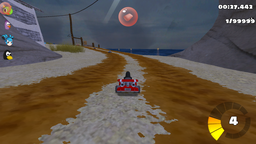
Played sessions
Testing is done with Walnut's rating tool (walnut-rate, on the console): how ratings are made and submitted.
Same in every session: Walnut 0.1
| Date | Launcher | Game build | Platform builds that differ | Rules | Play | Ended | Picture | |
|---|---|---|---|---|---|---|---|---|
| 2026-10-26 | SuperTuxKart | supertuxkart 1.5-2+ps3.833 | Linux kernel 6.12.111+ps3.786 Mesa 26.2.4-1+ps3.850 ps3rsx 0.788+k6.12.111+ps3.786 |
2.3 | 13 min | quit | ok | Details |
| 2026-10-26 | SuperTuxKart | supertuxkart 1.5-2+ps3.833 | Linux kernel 6.12.111+ps3.747 Mesa 26.2.4-1+ps3.827 ps3rsx 0.788+k6.12.111+ps3.786 |
2.3 | 12 min | crash | minor | Details |
| 2026-10-25 | SuperTuxKart | supertuxkart 1.5-2+ps3.786 | Linux kernel 6.12.111+ps3.747 Mesa 26.2.4-1+ps3.827 ps3rsx 0.735+k6.12.111+ps3.747 |
1.0 | 2 min | quit | wrong | Details |
Download all sessions as CSV (one row per session, the aspects as columns)
Rating history
The rating on each version it was tested on, newest first: each row is rated from that version's sessions alone, under the newest rules those sessions have the data for.
Scripted benchmarks
Not rated: tests of driver and game changes. A script plays the same scene on the PS3 again and again (the desktop stopped, vsync off) to compare two builds of the game or of the graphics driver. The numbers say which build is faster; they never feed the medal.
How the script plays it: SuperTuxKart 1.5. Its profile mode starts a race at once with every kart driven by the AI, drives for the given seconds, prints "Number of frames: N time T, Average FPS: F" and quits.
The recipe's full description
SuperTuxKart 1.5 (our build, gamedb/games/supertuxkart/packages/supertuxkart/: big-endian .spm loading, legacy-renderer fixes; 839 MB with its data, deployed by name). Its profile mode (--profile-time) starts a race at once with every kart driven by the AI, drives for the given seconds, prints "Number of frames: N time T, Average FPS: F" and quits. GL 2.1 picks the legacy renderer by itself ("Using the fixed pipeline"). RAM and VRAM are the risk (its FAQ wants 1 GB against our 217 MB): a small track and 4 karts. setup() writes the whole config (~/.config/supertuxkart/config-0.10/config.xml) every run, so the run doesn't depend on what an earlier one saved: the settings below, everything else at the game's defaults (a file without a key keeps that key's default). Names from src/config/ user_config.hpp; the file has one element per group with the settings as attributes. The game rewrites it when it quits (BACKUP restores it). base: the game's defaults (HD textures on: up to 2048x2048; texture compression on, which our 0004 makes reach the legacy renderer: opaque power-of-two textures as DXT1, compressed by Mesa at upload; the minimap shown, 512x512 render target with 0003), but vsync off and the old-driver popup off. Every variant changes one thing, except lean (the candidate PS3 default). Memory per run: during.log has MemAvailable and SwapFree every 5 s, bench.txt their lowest. Steady state: the HUD window, 60 s from the end of the track load (LOAD_MARK, the Track: line printed when the scene is built; the race starts at once, no countdown), then 120 s. Our patch 0005 (ProfileWorld::update) with STK_PROFILE_WARMUP=60 restarts the tick count and the clock once the race time passes 60 s and ends the race at 60 + the profile time (180 s: 240 s of race, 180 s measured); the "Average FPS" line it prints is ticks per second (see FPS_RE below). The race is AI-driven (rand() seeded from the clock, frame-time physics): close between runs, not identical.
The recipe today runs it at the game's own resolution, with STK_PROFILE_WARMUP=60. Older batches ran the recipe as it was then: their titles and observations say what changed (a new game build, a driver change).
11 variants of the recipe
base | the recipe as it is, without a variant |
|---|---|
nohd | HD textures off (bit 1: the user's choice, so the game doesn't turn them back on): textures are scaled down to max_texture_size (512) at load instead of 2048. The biggest single VRAM and RAM cut expected: a 2048x2048 RGBA8 texture is 16 MB, at 512 1 MB (DXT1: 128 KB) |
tex256 | the same capped at 256 |
notc | no texture compression: every texture RGBA8, as Debian's build (isolates 0004: VRAM, load time) |
nomap | minimap hidden: its render target (FBO texture plus depth buffer) isn't made (0003) |
noparticles | no particles (skid, nitro, weather, explosions): fewer billboards and their textures |
static | drivers not animated: the legacy renderer skins every animated kart on the CPU each frame |
geo0 | LOD switched at the shortest distances (Very Low): draw cost, not memory (every level is loaded) |
vsync | vsync on, the game's default (base turns it off) |
karts1 | fewer karts on the track (their models load at startup anyway; this is draw and AI cost) |
lean stands for the game | the candidate PS3 default if the single steps hold: HD textures off (512), compression on, no minimap, important particles only, static drivers |
One table, a header row per batch (what it tested and what came out). Conditions: what a variant adds to the recipe (its environment switches) and what ran alongside (the stall recorder, a profiler); a column appears only when this game has a value in it. Rows marked invalid or not comparable say why.
What the run length means
"warm-up + 120 s" is a steady-state run, which leaves out a 60 s warm-up and measures 120 s or more; "whole run" counted everything from the start, the way runs before 2026-10-17 did.
| Variant | Conditions | Steady fps in the window |
1% low fps |
Stalls frames over 100 ms |
fps whole run |
Build | Run length | ram free MiB | vram MiB | stall play s seconds | longest play ms ms | sound faults per min faults a minute | cpu seconds | underruns underruns | longest ms ms | stall disk s seconds | stall swap s seconds | stall reclaim s seconds | stall gpu s seconds | stall cpu s seconds |
Note |
|---|---|---|---|---|---|---|---|---|---|---|---|---|---|---|---|---|---|---|---|---|---|
Suite summary
2026-10-20 · suite-summary-2026-10
Tested: Not a test run: the suite's 13 benchmarked games (15 rows, with OpenArena's two renderers and OpenTTD's two blitters) gathered with their known numbers as of October 2026, each value naming the batch or document it came from. Result: It is the calibration of the rating formula (rules 1): the scale was tried on these numbers before any game was rated, and the GameDB calibration table is generated from it. Benchmarks never give a medal; medals come from played sessions only. | |||||||||||||||||||||
| SuperTuxKart lean | the recipe as it is | 21.0 | 11.8 | - | - | - | warm-up + 120 s | 26 | 97 | 1.8 | 513 | 3 | - | - | - | - | - | - | - | - | track draws, sound running |
batch ssdroot12 snd_ps3 DMA watchdog (kernel local/0047): dma_watchdog_ms=200 against 0 (off) on SuperTuxKart lean, OpenArena gl2min and ClassiCube base x3 (SSD root .472 Mesa ps3.545~dev, .472 with the test module)
2026-10-20 · 2026-10-20-ssdroot12-dma-watchdog
Tested: Whether the new snd_ps3 DMA watchdog (kernel patch 0047, which restarts the sound card's DMA when it stalls for 200 ms) prevents the OpenAL wedge, against the watchdog off, on SuperTuxKart, OpenArena and ClassiCube, three rounds. Result: Yes: with it off 2 of 9 runs wedged; with it on none did, two stalls were caught and restarted, and the sound kept going. Frame rates were equal. The watchdog stays on by default in the kernels since. What we saw18 runs rotated with system dumps on; one OpenArena run with the watchdog off was interfered by two logins and left out.
| |||||||||||||||||||||
lean |
stall recorder at 10 ms | 21 | 11.8 | 6 | 20 | Kernel ps3.472, Mesa ps3.545~dev | warm-up + 120 s | 26.1 | 95.0 | 1.0 | 291.1 | - | 318.4 | 0 | 291.1 | 0.1 | 0 | 0.1 | 0 | 0.8 | |
lean |
stall recorder at 10 ms switch snd_dma_watchdog_ms0 |
20 | 11.7 | 5 | 19 | Kernel ps3.472, Mesa ps3.545~dev | warm-up + 120 s | 29.2 | 96.0 | 0.6 | 126.1 | - | 323.5 | 0 | 126.1 | 0 | 0 | 0 | 0 | 0.6 | |
batch ssdroot10 OpenAL wedge rate on SuperTuxKart lean x5 per arm: our openal-soft +ps3.549 (int16), stock +ps3.273 (LDPATH), ours with OAL=f32 (SSD root .472 Mesa ps3.545~dev)
2026-10-20 · 2026-10-20-ssdroot10-openal-wedge
Tested: Whether our OpenAL build makes the sound wedge more likely than Debian's, and whether float output avoids it: five SuperTuxKart runs per arm. Result: No: our build wedged in 2 of 5 runs and Debian's in 3 of 5 (an earlier 0 of 12 for Debian's was luck). The wedge is the sound driver's DMA stopping whatever OpenAL does, the job of the snd_ps3 DMA watchdog (kernel patch 0047). Float output's 0 of 5 is not significant at five runs. What we saw15 runs rotated; one run with Debian's library was interfered by two logins and left out.
| |||||||||||||||||||||
lean |
stall recorder at 10 ms | 20 | 11.6 | 8 | 19 | Kernel ps3.472, Mesa ps3.545~dev | warm-up + 120 s | 23.4 | 95.7 | 1.3 | 255.3 | - | 322.7 | 0 | 255.3 | 0.1 | 0.0 | 0.0 | 0 | 1.0 | |
lean |
stall recorder at 10 ms switch ldstock-openal |
21.0 | 11.9 | 7.5 | 20.0 | Kernel ps3.472, Mesa ps3.545~dev | warm-up + 120 s | 25.9 | 95.0 | 1.1 | 216.0 | - | 315.7 | 0.0 | 216.0 | 0.1 | 0.0 | 0.0 | 0.0 | 0.9 | |
lean |
stall recorder at 10 ms switch oalf32 |
20 | 11.5 | 9 | 20 | Kernel ps3.472, Mesa ps3.545~dev | warm-up + 120 s | 21.4 | 95.9 | 1.1 | 157.8 | - | 313.2 | 0 | 157.8 | 0.1 | 0 | 0 | 0 | 0.8 | |
batch ssdroot9 Mesa 0044: NV30_MINMAX_VMX=1 against unset on SuperTuxKart lean x5 (SSD root .472 Mesa ps3.545~dev)
2026-10-20 · 2026-10-20-ssdroot9-minmax-vmx
Tested: A larger repeat (five rounds) of Mesa 0044 (the AltiVec index scan) on SuperTuxKart, after the first test gave an indicative +5%. Result: A gain: 22 against 20 fps (+10%), 1% low 12.3 against 11.6, gameplay stalls halved (0.6 against 1.2 s) and a little less CPU. Marked a candidate default; no decision to turn it on is recorded. What we saw10 runs rotated, 5 per arm, none interfered.
| |||||||||||||||||||||
lean |
stall recorder at 10 ms | 20 | 11.6 | 8 | 20 | Kernel ps3.472, Mesa ps3.545~dev | warm-up + 120 s | 24.1 | 95.1 | 1.2 | 205.6 | - | 319.6 | 0 | 205.6 | 0.1 | 0 | 0.0 | 0 | 1.0 | |
lean |
stall recorder at 10 ms switch minmax_vmx1 |
22 | 12.3 | 5 | 21 | Kernel ps3.472, Mesa ps3.545~dev | warm-up + 120 s | 27.8 | 95.9 | 0.6 | 143.7 | - | 307.4 | 0 | 143.7 | 0.0 | 0 | 0 | 0 | 0.5 | |
batch ssdroot8 DUMPON=1 repro of the OpenAL wedge: SuperTuxKart x4 OpenArena x3 ClassiCube x3 (SSD root .472 Mesa ps3.545~dev, stock snd_ps3)
2026-10-20 · 2026-10-20-ssdroot8-openal-wedge
Tested: Another reproduction of the OpenAL wedge with system dumps, on SuperTuxKart, OpenArena and ClassiCube, with the stock snd_ps3 sound driver. Result: The real wedge (OpenAL waiting on a sound card that stopped) hit 3 of 10 runs: 2 of 4 SuperTuxKart, 0 of 3 OpenArena and 1 of 3 ClassiCube. In one, the card's position had stood still for a second before, as in the first count. The other dumps caught short underruns that recovered; investigation runs, not for comparison. What we sawInvestigation runs, not for fps: a dump freezes the game for seconds. Only runs without a dump have numbers, not comparable with other batches. Webcam picture right in all 10; dumps in 8 of 10.
| |||||||||||||||||||||
lean-- |
stall recorder at 10 ms | - | - | - | 19.5 | Kernel ps3.472, Mesa ps3.545~dev | whole run | 13.2 | - | - | - | - | - | - | - | - | - | - | - | - | |
lean |
stall recorder at 10 ms | 20.5 | 11.7 | 6.0 | 20.0 | Kernel ps3.472, Mesa ps3.545~dev | warm-up + 120 s | 23.0 | 95.5 | 0.8 | 142.2 | - | 320.3 | 0.0 | 142.2 | 0.0 | 0.0 | 0.0 | 0.0 | 0.7 | |
batch ssdroot8 Mesa 0038 force-DXT on the rest of the suite: Luanti and ClassiCube off/opaque/opaque+NEAREST, OpenArena gl2min and gl2min_tc0 off/opaque, SuperTuxKart lean opaque/all (SSD root .472 Mesa ps3.545~dev)
2026-10-20 · 2026-10-20-ssdroot8-force-dxt
Tested: Whether Mesa 0038's forced texture compression (opaque textures to DXT1, or every texture with 'all') saves VRAM in the rest of the suite: Luanti, ClassiCube, OpenArena and SuperTuxKart. Result: Only SuperTuxKart with 'all' changed anything: 182 textures went to DXT5 and peak VRAM fell from 95.5 to 58.1 MiB (-39%) at the same frame rate, with no difference visible on the webcam. The other games compressed nothing, because their uploads are empty textures filled later, small, or in formats the switch skips. No decision recorded; the user has the last word on the picture. What we saw24 runs, compression statistics on in every arm, none interfered, webcam picture right in all.
| |||||||||||||||||||||
lean |
stall recorder at 10 ms switch force_dxtall_force_dxt_stats50 |
20.5 | 11.4 | 10.5 | 19.5 | Kernel ps3.472, Mesa ps3.545~dev | warm-up + 120 s | 28.6 | 58.0 | 1.4 | 225.7 | - | 316.2 | 0.0 | 225.7 | 0.0 | 0.0 | 0.0 | 0.0 | 1.4 | |
lean |
stall recorder at 10 ms switch force_dxtopaque_force_dxt_stats50 |
20.0 | 11.2 | 12.0 | 20.0 | Kernel ps3.472, Mesa ps3.545~dev | warm-up + 120 s | 28.1 | 95.5 | 1.8 | 309.8 | - | 316.6 | 0.0 | 309.8 | 0.1 | 0.0 | 0.0 | 0.0 | 1.6 | |
batch ssdroot7 DUMPON=1 repro of the OpenAL wedge: SuperTuxKart x4 OpenArena x3 ClassiCube x3 Sauerbraten x3 (SSD root .472 Mesa ps3.545~dev)
2026-10-19 · 2026-10-19-ssdroot7-openal-wedge
Tested: How often OpenAL's sound output wedges (stops) in four games, with a full system dump taken the moment it happens, to find the cause. Result: The wedge hit 3 of 4 SuperTuxKart runs, 1 of 3 OpenArena, 1 of 3 ClassiCube and none of 3 BananaBread, as early as 21 s in. The dumps showed the sound card's DMA stopping in the kernel's snd_ps3 driver. Investigation runs: their numbers are not for comparison. What we sawInvestigation runs, not for fps: a dump freezes the game for seconds, and the dump mode itself costs (OpenArena's window was 71 s at 57 fps against 94 s at 62 fps without it). Only the 8 of 13 runs without a dump have numbers, and they are not comparable with other batches.
| |||||||||||||||||||||
lean |
stall recorder at 10 ms | 20 | 11.3 | 8 | 19 | Kernel ps3.472, Mesa ps3.545~dev | warm-up + 120 s | 25.6 | 95.0 | 0.9 | 126.9 | - | 323.1 | 0 | 126.9 | 0.0 | 0 | 0.0 | 0 | 0.8 | |
batch ssdroot7 Mesa 0044: NV30_MINMAX_VMX=1 against unset on SuperTuxKart lean x3 (SSD root .472 Mesa ps3.545~dev)
2026-10-19 · 2026-10-19-ssdroot7-minmax-vmx
Tested: Whether Mesa 0044 (AltiVec code for the min/max scan of index arrays, 6.5% of SuperTuxKart's profile) makes SuperTuxKart faster, three rounds. Result: Indicative +5%: 22 fps in every run with it against 19-21 without, but one fps is the HUD's resolution and the CPU time did not fall. Not proven; repeated with five rounds. What we saw6 runs rotated, 3 per arm, none interfered, webcam picture right in all.
| |||||||||||||||||||||
lean |
stall recorder at 10 ms | 21 | 12.0 | 6 | 20 | Kernel ps3.472, Mesa ps3.545~dev | warm-up + 120 s | 24.4 | 94.6 | 0.8 | 231.5 | - | 305.2 | 0 | 231.5 | 0.1 | 0.0 | 0 | 0 | 0.6 | |
lean |
stall recorder at 10 ms switch minmax_vmx1 |
22 | 12.3 | 6 | 21 | Kernel ps3.472, Mesa ps3.545~dev | warm-up + 120 s | 26.5 | 96.1 | 0.8 | 185.2 | - | 313.2 | 0 | 185.2 | 0.1 | 0 | 0.1 | 0 | 0.7 | |
batch ssdroot6 libpng: libpng16 1.6.59 +ps3.560 against Debian's stock on SuperTuxKart lean x3 and Sauerbraten base x3 and OpenArena gl2min x2 (SSD root .472 Mesa ps3.545~dev zlib-ng on both arms)
2026-10-19 · 2026-10-19-ssdroot6-libpng
Tested: Whether our libpng (1.6.59 +ps3.560) cuts load times against Debian's, mainly on SuperTuxKart, whose load profile showed 4 s of PNG decoding; BananaBread and OpenArena as controls, zlib-ng on in both arms. Result: Yes for SuperTuxKart: PNG decoding in the load fell from 4.0 to 1.6 s (-60%, as predicted) and the whole load from 30.3 to 27.6 s (-9%), with gameplay unchanged. Nothing measurable for BananaBread and OpenArena. Our libpng later replaced Debian's on the PS3. What we sawWebcam picture right in all runs.
| |||||||||||||||||||||
lean |
stall recorder at 10 ms start-up profile switch zng |
19.5 | 11.5 | 10.0 | 19.5 | Kernel ps3.472, Mesa ps3.545~dev | warm-up + 120 s | 19.8 | 95.4 | 1.2 | 172.6 | - | 320.4 | 0.0 | 172.6 | 0.1 | 0.0 | 0.0 | 0.0 | 1.1 | |
lean |
stall recorder at 10 ms start-up profile switch zng switch ldstock-png |
20.0 | 11.8 | 10.5 | 19.5 | Kernel ps3.472, Mesa ps3.545~dev | warm-up + 120 s | 27.3 | 95.7 | 1.4 | 198.8 | - | 322.5 | 0.0 | 198.8 | 0.1 | 0.0 | 0.0 | 0.0 | 1.2 | |
batch ssdroot5 load-time libraries: libvorbis +ps3.549 and zlib-ng against stock on SuperTuxKart lean and Sauerbraten base x3, JSIMD=none x2 (SSD root .472 Mesa ps3.544)
2026-10-19 · 2026-10-19-ssdroot5-load-libraries
Tested: Whether our libvorbis (+ps3.549) and zlib-ng shorten load times against Debian's libraries, on SuperTuxKart and BananaBread, three rounds; plus two runs with libjpeg-turbo's AltiVec code turned off to see whether it is in use. Result: Small gains on SuperTuxKart's load: 0.7 s from libvorbis and 0.9 s from zlib-ng. BananaBread's load and all frame rates were unchanged. Both libraries became defaults later (our libvorbis replaces Debian's; zlib-ng is loaded for every game), and the AltiVec test showed libjpeg-turbo's AltiVec path is in use. What we sawLoad-time profiling on, 22 runs.
| |||||||||||||||||||||
lean |
stall recorder at 10 ms start-up profile |
21 | 11.9 | 6 | 20 | Kernel ps3.472, Mesa ps3.544 | warm-up + 120 s | 27.9 | 95.9 | 0.8 | 151.8 | - | 321.9 | 0 | 151.8 | 0 | 0 | 0.1 | 0 | 0.7 | |
lean |
stall recorder at 10 ms start-up profile switch jsimdnone |
20.5 | 11.9 | 8.5 | 20.0 | Kernel ps3.472, Mesa ps3.544 | warm-up + 120 s | 31.0 | 95.4 | 1.4 | 442.6 | - | 321.4 | 0.0 | 442.6 | 0.1 | 0.0 | 0.2 | 0.0 | 1.0 | |
lean |
stall recorder at 10 ms start-up profile switch ldstock-vorbis |
21 | 12.0 | 5 | 20 | Kernel ps3.472, Mesa ps3.544 | warm-up + 120 s | 25.4 | 96.1 | 1.2 | 427.2 | - | 320.5 | 0 | 427.2 | 0.1 | 0 | 0.3 | 0 | 0.6 | |
lean |
stall recorder at 10 ms start-up profile switch zng |
20 | 11.7 | 7 | 20 | Kernel ps3.472, Mesa ps3.544 | warm-up + 120 s | 24.9 | 95.9 | 0.8 | 141.2 | - | 325.4 | 0 | 141.2 | 0.1 | 0 | 0 | 0 | 0.8 | |
batch ssdroot2 P2: Mesa 0038 NV30_FORCE_DXT=opaque against off (MEM=1 STALLS=1 NV30_FORCE_DXT_STATS=50)
2026-10-19 · 2026-10-19-ssdroot2-force-dxt
Tested: Mesa 0038, a switch that compresses opaque textures to DXT on upload to save VRAM, against off on BananaBread, SuperTuxKart and OpenArena. Result: In BananaBread it cuts peak VRAM from 119.8 MB (the cap) to 73-78 MB with no frame rate change and a slightly softer picture. It compresses nothing in SuperTuxKart and OpenArena, whose textures it skips, so no effect there. What we saw
| |||||||||||||||||||||
lean |
stall recorder at 10 ms switch force_dxt_stats50 |
20.0 | 10.6 | 17.5 | 19.5 | - | warm-up + 120 s | 27.6 | 96.2 | 2.8 | 480.2 | - | 323.1 | 0.0 | 480.2 | 0.2 | 0.0 | 0.2 | 0.0 | 2.4 | |
lean |
stall recorder at 10 ms switch force_dxtopaque_force_dxt_stats50 |
21.0 | 11.6 | 11.5 | 20.0 | - | warm-up + 120 s | 24.6 | 95.0 | 1.7 | 385.5 | - | 318.3 | 0.0 | 385.5 | 0.1 | 0.0 | 0.3 | 0.0 | 1.3 | |
batch ssdroot2 P1b: gameplay profiles on the SSD root (PERF=1 MEM=1 x1)
2026-10-19 · 2026-10-19-ssdroot2-gameplay-profiles
Tested: Where the CPU goes during play in seven games on the SSD root, profiled with perf over the measured window. Result: Mesa is the biggest share in BananaBread (62.8%) and ClassiCube, the game itself in SuperTuxKart, OpenArena and Luanti, and OpenTTD spends half its time in the kernel. Profiled runs, not for frame rates; OpenTTD was profiled at its title screen, not in play. What we saw
not comparable gameplay profiles (PERF=1 MEM=1), slower than plain runs. | |||||||||||||||||||||
leannot comparable |
perf recording | 20 | 10.8 | 20 | 20 | - | warm-up + 120 s | 22.9 | 94.5 | 2.7 | 316.8 | - | 322.5 | 0 | 316.8 | - | - | - | - | - | |
batch ssdroot2 P1a: start-up profiles on the SSD root (PERF_LOAD=1 STALLS=1 x1)
2026-10-19 · 2026-10-19-ssdroot2-startup-profiles
Tested: Where the start-up time goes now that the system runs from the SSD: one profiled start of each of five games, from a cold cache. Result: Loads are 39-61% shorter than on USB and are now mostly CPU work on the main thread (47-77%), with the disk only 13-26%. The biggest remaining costs are named per game (map inflate, PNG and zlib decoding, Luanti's map generation). Profiled runs, not for frame rates. What we saw
not comparable start-up profiles (PERF_LOAD=1 STALLS=1), slower than plain runs. | |||||||||||||||||||||
leannot comparable |
stall recorder at 10 ms start-up profile |
21 | 12.0 | 5 | 20 | - | warm-up + 120 s | 23.5 | 95.7 | 0.6 | 151.3 | - | 316.1 | 0 | 151.3 | 0 | 0 | 0 | 0 | 0.6 | |
batch ssdroot1+2 A: baseline on the SSD root (kernel .472 Mesa .476 ps3rsx 0.443 ps3-gpu-tools 0.477~dev)
2026-10-19 · 2026-10-19-ssdroot1-baseline
Tested: A new baseline with the whole system running from the internal SSD instead of a USB disk, on five games, to see what it does to loads, stalls and frame rates. This console has an upgraded SSD; a stock PS3 has a hard disk. Result: Loads are 35-58% shorter (BananaBread 16.9 to 7.1 s, SuperTuxKart 53.6 to 31.1 s) and BananaBread's gameplay stalls almost vanish, while frame rates stay about the same apart from OpenArena (55.9 to 60.4). It also showed SuperTuxKart's own "Average FPS" is its physics tick rate, so its fps is taken from the HUD from here on. What we saw
| |||||||||||||||||||||
lean |
stall recorder at 10 ms | 22 | 12.8 | 2 | 21 | Kernel ps3.472, Mesa ps3.476, ps3rsx 0.443 | warm-up + 120 s | 25.1 | 94.8 | 0.2 | 108.3 | - | 308.3 | 0 | 108.3 | 0 | 0 | 0 | 0 | 0.2 | |
batch 17: ETR uncapped, start-up profiles x5, shader cache cold/warm, OpenArena gl2 memory variants, Mesa sysmem switches, Sauerbraten shortnormals
2026-10-18 · 2026-10-18-batch17
Tested: A mixed batch: ioquake3 462's new colour path and memory variants for OpenArena's OpenGL 2 renderer, Mesa's system-memory copy switches, BananaBread's short normals, a warm shader cache, Extreme Tux Racer without a frame cap, and start-up profiles. Result: ioquake3 462 cuts OpenArena's stalls from 9-11 s to 0.7-2.6 s at 57-60 fps, Mesa's system-memory switches fix the old colour path's stalls, and BananaBread's short normals give +17%. The shader cache gives no faster loads and Extreme Tux Racer's 59 fps is not a vsync cap. What we saw
| |||||||||||||||||||||
lean |
stall recorder at 10 ms start-up profile |
19 | 11.5 | 8 | 19 | - | warm-up + 120 s | 22.5 | 96.1 | 2.0 | 691.2 | - | 335.3 | 0 | 691.2 | 0.4 | 0.0 | 0 | 0 | 0.7 | |
batch 16: game prefetch A/B, idle fix on/off (433), ClassiCube chunks1, X-Moto stream, Luanti lean parts
2026-10-18 · 2026-10-18-batch16
Tested: Several checks on kernel .433: a game-data prefetch, the idle-CPU fix on and off, ClassiCube's chunk setting, X-Moto's streaming draw path, and the parts of Luanti's lean settings one at a time. Result: The prefetch gives no gain and makes Luanti worse, so it was turned off by default. The idle fix is confirmed clean (gameplay stalls 0.4 s against 8-9 s); ClassiCube's chunk setting gains 4.7% and X-Moto's streaming 1%. Luanti's chunk size 3 is what empties the world in lean. What we saw
| |||||||||||||||||||||
lean |
gpflearn | 21 | 12.1 | 6 | 20 | - | warm-up + 120 s | 26.7 | 95.9 | 1.3 | 432.6 | - | 331.1 | 0 | 432.6 | - | - | - | - | - | |
lean |
stall recorder at 10 ms | 20 | 11.4 | 7 | 19 | - | warm-up + 120 s | 23.9 | 95.2 | 1.8 | 686.1 | - | 330.8 | 0 | 686.1 | 0.4 | 0.0 | 0 | 0 | 0.7 | |
lean |
stall recorder at 10 ms switch gpffetch |
20 | 11.5 | 12 | 20 | - | warm-up + 120 s | 24.4 | 96.1 | 2.7 | 682.4 | - | 330.6 | 0 | 682.4 | 0.5 | 0.0 | 0 | 0 | 1.1 | |
batch 8: STK lean, OpenTTD gl, ClassiCube/dsda batching, malloc presets, profiles (Mesa ps3.408, kick)
2026-10-18 · 2026-10-18-batch8
Tested: A mixed batch: SuperTuxKart's lean settings, OpenTTD's OpenGL driver, draw batching in ClassiCube and dsda-doom, memory allocator presets, and profiles of OpenArena and Luanti. Result: SuperTuxKart lean runs 21.4 fps against 13 with far fewer stalls, OpenTTD's GL driver doubles its frame rate, dsda-doom's batching gains 3% while ClassiCube's loses 4%, and the allocator presets were noise. One Luanti profiling run was disturbed by a mouse click. What we saw
| |||||||||||||||||||||
base |
waker kick at 10 ms | 12 | 8.4 | 113 | 12 | Mesa ps3.408 | warm-up + 120 s | 24.4 | 129.7 | 13.5 | 675.6 | - | 412.3 | 0 | 675.6 | - | - | - | - | - | |
lean |
waker kick at 10 ms | 21 | 12.2 | 8 | 21 | Mesa ps3.408 | warm-up + 120 s | 18.5 | 95.7 | 2.4 | 663.4 | - | 318.1 | 0 | 663.4 | - | - | - | - | - | |
lean |
waker kick at 10 ms perf recording |
20 | 10.8 | 15 | 20 | Mesa ps3.408 | warm-up + 120 s | 27.6 | 95.0 | 3.4 | 576.3 | - | 325.4 | 0 | 576.3 | - | - | - | - | - | |
Group 4 smokes (Mesa ps3.246 + ps3rsx 0.249)
2026-10-17 · 2026-10-17-group4-smokes
Tested: First runs of the heavy games with the VRAM swap on: OpenArena's OpenGL 2 renderer with two settings, SuperTuxKart, and BananaBread with GPU and with CPU skinning. Result: The heavy games are memory-bound, with no driver bug in sight: OpenArena's OpenGL 2 renderer made 10.7 to 13.6 fps with single stalls of 28.3 and 36.3 s. SuperTuxKart refused to start on a big-endian machine, and BananaBread's GPU skinning was far slower than CPU skinning. What we saw
| |||||||||||||||||||||
base |
the recipe as it is | - | - | - | - | Mesa ps3.246, ps3rsx 0.249 | whole run | 48.9 | 100.0 | - | - | - | 13.8 | 0 | - | - | - | - | - | - | |