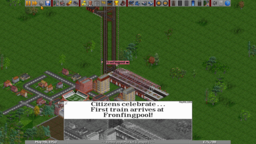
Played sessions
Testing is done with Walnut's rating tool (walnut-rate, on the console): how ratings are made and submitted.
Same in every session:
Walnut 0.1,
openttd 15.1-1+ps3.721
The platform builds under it (3)
| Linux kernel | 6.12.111+ps3.747 Walnut's build |
|---|---|
| Mesa | 26.2.4-1+ps3.819 Walnut's build |
| ps3rsx | 0.735+k6.12.111+ps3.747 Walnut's build |
| Date | Launcher | Rules | Play | Ended | Picture | |
|---|---|---|---|---|---|---|
| 2026-10-25 | OpenTTD (software) | 1.0 | 3 min | quit | ok | Details |
| 2026-10-25 | OpenTTD (OpenGL) | 1.0 | 6 min | quit | ok | Details |
Download all sessions as CSV (one row per session, the aspects as columns)
Rating history
The rating on each version it was tested on, newest first: each row is rated from that version's sessions alone, under the newest rules those sessions have the data for.
OpenTTD (OpenGL)
| Version | Tested | Medal | Rules | Frame rate | Smoothness | Sound | Picture | Stability | Display | Load | Play |
|---|---|---|---|---|---|---|---|---|---|---|---|
| Walnut 0.1 openttd 15.1-1 |
2026-10-25 | Gold · 83 | 1.0 | 74 | 64 | 97 | 100 | 90 | - | 96 | 0.1 h 1 test |
OpenTTD (software)
| Version | Tested | Medal | Rules | Frame rate | Smoothness | Sound | Picture | Stability | Display | Load | Play |
|---|---|---|---|---|---|---|---|---|---|---|---|
| Walnut 0.1 openttd 15.1-1 |
2026-10-25 | Untested | 1.0 | - | - | 79 | 100 | 90 | - | - | 0.1 h 1 test |
Scripted benchmarks
Not rated: tests of driver and game changes. A script plays the same scene on the PS3 again and again (the desktop stopped, vsync off) to compare two builds of the game or of the graphics driver. The numbers say which build is faster; they never feed the medal.
How the script plays it: OpenTTD 15.1 with OpenGFX/OpenSFX/OpenMSX. base: a real game. assets/openttd-bench.sav: 1962, 30 towns, 318 stations, 132 trains, 600 road vehicles, 5 ships, 83 aircraft.
The recipe's full description
OpenTTD 15.1 (Debian, our openttd package for the GL driver) with OpenGFX/OpenSFX/OpenMSX. base: a real game (2026-10-19). assets/openttd-bench.sav: 1962, 30 towns (65000 inhabitants), 318 stations, 132 trains, 600 road vehicles, 5 ships, 83 aircraft (a 256x256 map, played by six AIs for 12 years on the PC, then every company made a human one: no script runs, no AI window, no news; made with assets-src/). Loaded from the command line (-g), 1920x1080 fullscreen, the camera on Taningville (a city of 5000 with a rail station and a bus hub, ~35 vehicles within 16 tiles) at the normal zoom, the game at normal speed for the whole run (OpenTTD has no timedemo: a fixed duration; the game thread's work per frame is the same, the vehicle positions drift with the wall clock). The GL driver (-v sdl-opengl, our package) with the package's default blitter (8bpp-optimized since patch 0003; the ps3.297 package and Debian's use 32bpp-anim: the batches of 2026-10-19 ran the old default as `base`), fps from the Gallium HUD (the load ends at the HUD's first frame, 60 s warm-up, 120 s measured, then the game is stopped). Sound and music on as in play: the SDL sound driver at 44.1 kHz and the FluidSynth music driver with the first soundfont it finds (TimGM6mb on the image), OpenMSX playing. setup()'s config turns autosave off, the news popups off (no pause dialogs) and the survey off (OpenTTD 14+ asks on the first start). The AI window can't open: no AI is left in the save. The PS3 needs the image's openttd, openttd-opengfx, openttd-opensfx, openttd-openmsx and fluidsynth with a soundfont (all from Debian), no NewGRF, no AI. sw: the same game with the SDL software video driver through plain X11 (SDL3's accelerated window framebuffer shows a blue cast on big-endian until the SDL3 fix): no GL, so no HUD and no fps (CPU profiles, stalls, memory); the window starts at the savegame's load line ("Loading savegame version", -d sl=1) + 60 s, 120 s measured swaccel: sw with SDL3's accelerated window framebuffer (HUD fps: the SDL renderer is GL) zoomout: base from assets/openttd-bench-far.sav: the same city one zoom step out (4x the area, ~4x the sprites and station names on screen) scroll: base with the camera panned by the keyboard (xkeys.py through XTEST): Right for 3 s, Left for 3 s, over and over from the window's warm-up on; OpenTTD scrolls by the clock, so the pan covers the same ground at any frame rate. Left/Right only: Up/Down clamp at the map's edge from this camera and don't come back nosound: effects off (-s null); nomusic: music off (-m null); quiet: both off hz22, buf2048, buf4096: the SDL sound driver at 22.05 kHz (the mixer's rate, which the FluidSynth music renders at too: half the synthesis), and with a 2048 or 4096 frame buffer (46 or 93 ms at 44.1 kHz; the default is 1024 = 23 ms): sound candidates for underruns blit8, blit32, blit32anim: base with the 8bpp-optimized, 32bpp-optimized or 32bpp-anim blitter (32bpp-anim, the stock default and ours before patch 0003, is a 32-bit video buffer plus an 8-bit animation buffer, both mapped from a pixel buffer object that the CPU blends sprites into): blit32anim is the old default, for comparisons with the batches before 0003 title: until 2026-10-18 base: the title screen's own demo game (trains running, the camera panning by itself) with the software driver through X11, no HUD (the window starts at the title game's load + 60 s). The title game is a savegame with its random state (deterministic, no AIs), but its ticks and the camera's sign-driven pans run on the wall clock. gl, accel, accel8 are title variants too (the GL driver; SDL3's accelerated framebuffer; that with the 8bpp-optimized blitter), as they were. simplay: the bench save's simulation only (null driver, 6000 ticks, exits by itself) sim: simulation only, no video (null driver): a new game from a fixed seed, run for 20000 ticks and timed (a CPU benchmark; it exits by itself) The PS3 runs: `run.sh smoke openttd` (one run, 360 s at most), `run.sh bench openttd "base zoomout"`.
The recipe today runs it at the game's own resolution, with vblank_mode=0 (vsync off). Older batches ran the recipe as it was then: their titles and observations say what changed (a new game build, a driver change).
20 variants of the recipe
base stands for the game | the recipe as it is, without a variant |
|---|---|
sw | - |
swaccel | - |
zoomout | - |
scroll | - |
nosound | - |
nomusic | - |
quiet | - |
hz22 | - |
buf2048 | - |
buf4096 | - |
blit8 | - |
blit32 | - |
blit32anim | - |
title | the title screen's demo game, as base was until 2026-10-18 (software video, no HUD) |
simplay | the bench save's simulation without video: 6000 ticks (a quarter of a game year; 7 s on the PC, 830 ticks a second there against the 33 a second the game needs in real time): the CPU cost of 800 vehicles and 30 towns, no drawing, no sound; exits by itself |
sim | - |
gl | the title game with the sdl-opengl driver (the package's default blitter: 32bpp-anim before patch 0003, with sprites drawn on the CPU and the palette animation and the screen upload on the GPU); needs our openttd package (gamedb/games/openttd/packages/openttd/: Debian's refuses nv30, no ARB_texture_rg); compare with title and accel -d driver=2: the GL renderer, the luminance fallback and shader compiler warnings on stderr |
accel | the title game with SDL3's default accelerated framebuffer (to check the SDL3 fix) |
accel8 | the accelerated framebuffer with OpenTTD's cheapest blitter (8-bit palette; the default is 32bpp-anim, which redraws palette animation per pixel in software) |
One table, a header row per batch (what it tested and what came out). Conditions: what a variant adds to the recipe (its environment switches) and what ran alongside (the stall recorder, a profiler); a column appears only when this game has a value in it. Rows marked invalid or not comparable say why.
What the run length means
"warm-up + 120 s" is a steady-state run, which leaves out a 60 s warm-up and measures 120 s or more; "whole run" counted everything from the start, the way runs before 2026-10-17 did.
| Variant | Conditions | Steady fps in the window |
1% low fps |
Stalls frames over 100 ms |
fps whole run |
Build | Run length | ram free MiB | vram MiB | stall play s seconds | longest play ms ms | sound faults per min faults a minute | cpu seconds | underruns underruns | longest ms ms | stall disk s seconds | stall swap s seconds | stall reclaim s seconds | stall gpu s seconds | stall cpu s seconds |
Note |
|---|---|---|---|---|---|---|---|---|---|---|---|---|---|---|---|---|---|---|---|---|---|
Suite summary
2026-10-20 · suite-summary-2026-10
Tested: Not a test run: the suite's 13 benchmarked games (15 rows, with OpenArena's two renderers and OpenTTD's two blitters) gathered with their known numbers as of October 2026, each value naming the batch or document it came from. Result: It is the calibration of the rating formula (rules 1): the scale was tried on these numbers before any game was rated, and the GameDB calibration table is generated from it. Benchmarks never give a medal; medals come from played sessions only. | |||||||||||||||||||||
| OpenTTD, 8bpp | the recipe as it is | 38.3 | 13.4 | - | - | - | warm-up + 120 s | 41 | 18 | 0.4 | 210 | 3500 | - | - | - | - | - | - | - | - | right, choppy (3500-4700 underruns) |
| OpenTTD, 32bpp | the recipe as it is | 11.0 | 5.7 | - | - | - | warm-up + 120 s | 17 | 18 | 52.0 | 311 | 3500 | - | - | - | - | - | - | - | - | right, choppy (3500-4700 underruns) |
RT audio thread: SCHED_RR 1 from outside (RTPRIO=10+RTTHREAD) and nice -20 (NICELIM=40) against none on dsda-doom software (owncfg), Extreme Tux Racer and OpenTTD (kernel .874)
2026-10-28 · 2026-10-28-rt-audio-thread
Tested: Whether putting the game's own audio thread on real-time priority (SCHED_RR 1, set from outside) or running the game at nice -20 stops the audible dropouts in dsda-doom (software renderer), Extreme Tux Racer and OpenTTD. Result: SCHED_RR clearly helps: median dropouts a run fell from 19 to 2 in dsda-doom and from 24 to 3.5 in Extreme Tux Racer, at no frame-rate cost. nice -20 helped less and cost dsda-doom 2%. A per-game opt-in was recommended; not shipped in this form. What we saw38 runs in four rounds, order rotated. 14 were interfered by another agent's SSH logins and left out. Every counted run was fullscreen at 1920x1080 and in gameplay at its 40 s screenshot.
| |||||||||||||||||||||
base |
nicelim40 | 43 | 15.4 | 0 | 43 | - | warm-up + 120 s | 45.3 | 17.9 | 0.0 | 98.2 | - | 257.5 | 1095 | 98.2 | - | - | - | - | - | |
base |
real-time priority 0 | 42.0 | 15.3 | 1.0 | 42.0 | - | warm-up + 120 s | 44.6 | 17.9 | 0.1 | 101.3 | - | 261.5 | 2018.5 | 101.3 | - | - | - | - | - | |
batch ssdroot5 FluidSynth on OpenTTD base x3: divide-free reverb (libfluidsynth3 +ps3.549), Debian's stock (LDPATH), effects off (SSD root .472 Mesa ps3.544)
2026-10-19 · 2026-10-19-ssdroot5-fluidsynth
Tested: Whether our FluidSynth build with a reverb that avoids divisions (libfluidsynth3 +ps3.549) is faster than Debian's, and what turning the synthesizer's effects off would save, on OpenTTD with its music, three rounds. Result: Our build gave 35 against 34 fps (+3%) and later replaced Debian's on the PS3. With the effects off OpenTTD ran 40 fps (+18%); turning them off waits for the user to judge the music by ear. What we saw9 runs rotated.
| |||||||||||||||||||||
base |
stall recorder at 10 ms | 35 | 13.2 | 8 | 34 | Kernel ps3.472, Mesa ps3.544 | warm-up + 120 s | 43.7 | 17.9 | 0.9 | 133.1 | - | 259.9 | 3808 | 133.1 | 0 | 0 | 0.0 | 0.0 | 0.8 | |
base |
stall recorder at 10 ms switch fxoff |
40 | 14.3 | 3 | 38 | Kernel ps3.472, Mesa ps3.544 | warm-up + 120 s | 38.1 | 17.9 | 0.3 | 118.3 | - | 251.4 | 2730 | 118.3 | 0 | 0.0 | 0 | 0 | 0.3 | |
base |
stall recorder at 10 ms switch ldstock-fluid |
34 | 13.3 | 7 | 32 | Kernel ps3.472, Mesa ps3.544 | warm-up + 120 s | 37.1 | 17.9 | 0.8 | 145.0 | - | 263.6 | 3925 | 145.0 | 0 | 0 | 0 | 0.0 | 0.7 | |
batch ssdroot5 OpenTTD views with Mesa 0040 on: base, zoomout, scroll x2 (SSD root .472 Mesa ps3.544, 8bpp-optimized)
2026-10-19 · 2026-10-19-ssdroot5-openttd-views
Tested: How OpenTTD's heavy views (zoomed out, and a scrolling camera) run with Mesa 0040's staging pool on, after both had dropped to 7 fps without it; 8bpp-optimized blitter, two rounds. Result: The pool lifts them: zoomed out from 7 to 23 fps and scrolling from 7 to 31 fps, compared with the blitter batch without the pool. The 8 MB staging buffer per frame was the cost of those views. What we sawThe staging pool on in every arm, 8bpp-optimized blitter, 6 runs.
| |||||||||||||||||||||
base |
stall recorder at 10 ms switch staging_pool_mb24 |
52.0 | 18.6 | 1.0 | 50.5 | Kernel ps3.472, Mesa ps3.544 | warm-up + 120 s | 41.7 | 17.9 | 0.1 | 110.3 | - | 230.5 | 3135.0 | 110.3 | 0.0 | 0.0 | 0.0 | 0.0 | 0.1 | |
scroll |
stall recorder at 10 ms switch staging_pool_mb24 |
31.0 | 14.3 | 5.0 | 33.0 | Kernel ps3.472, Mesa ps3.544 | warm-up + 120 s | 38.8 | 17.9 | 0.8 | 280.4 | - | 252.3 | 3506.0 | 280.4 | 0.0 | 0.0 | 0.1 | 0.0 | 0.5 | |
zoomout |
stall recorder at 10 ms switch staging_pool_mb24 |
23.0 | 11.1 | 12.5 | 22.5 | Kernel ps3.472, Mesa ps3.544 | warm-up + 120 s | 34.2 | 17.9 | 1.5 | 161.1 | - | 253.2 | 3454.0 | 161.1 | 0.0 | 0.0 | 0.1 | 0.0 | 1.2 | |
batch ssdroot4 Mesa 0040: NV30_STAGING_POOL_MB=24 against off on OpenTTD base (32bpp-anim) and blit8 (8bpp-optimized) x3, the 1962 savegame (SSD root .472 Mesa ps3.544)
2026-10-19 · 2026-10-19-ssdroot4-staging-pool
Tested: Whether Mesa 0040 (a 24 MB pool that reuses big staging buffers for texture uploads) speeds up OpenTTD, which uploads its whole screen as a texture every frame; on both the 32bpp-anim and 8bpp-optimized blitters, three rounds. Result: Yes, by a lot: the 8bpp blitter went from 34 to 52 fps and 32bpp-anim from 11 to 20 fps, whose stalls fell from 43 to 4.3 s, with the same picture. The pool is off by default in Mesa; no decision to turn it on is recorded. What we saw12 runs rotated, plus one profiled run of base with the pool (not for comparison).
| |||||||||||||||||||||
base |
perf recording switch staging_pool_mb24 |
20 | 9.6 | 30 | 20 | Kernel ps3.472, Mesa ps3.544 | warm-up + 120 s | 13.9 | 25.8 | 4.7 | 532.2 | - | 263.1 | 3905 | 532.2 | - | - | - | - | - | |
base |
stall recorder at 10 ms | 11 | 5.8 | 350 | 10 | Kernel ps3.472, Mesa ps3.544 | warm-up + 120 s | 21.2 | 17.9 | 43.7 | 323.9 | - | 271.5 | 3548 | 323.9 | 0 | 0.1 | 0.1 | 1.5 | 40.3 | |
base |
stall recorder at 10 ms switch staging_pool_mb24 |
20 | 9.4 | 39 | 20 | Kernel ps3.472, Mesa ps3.544 | warm-up + 120 s | 16.6 | 17.9 | 5.1 | 521.7 | - | 256.4 | 3943 | 521.7 | 0 | 0.0 | 0.7 | 0.2 | 3.7 | |
blit8 |
stall recorder at 10 ms | 34 | 13.0 | 5 | 33 | Kernel ps3.472, Mesa ps3.544 | warm-up + 120 s | 38.8 | 17.9 | 0.6 | 128.1 | - | 264.4 | 4027 | 128.1 | 0 | 0 | 0 | 0 | 0.5 | |
blit8 |
stall recorder at 10 ms switch staging_pool_mb24 |
52 | 18.4 | 1 | 51 | Kernel ps3.472, Mesa ps3.544 | warm-up + 120 s | 38.7 | 17.9 | 0.1 | 108.5 | - | 229.9 | 3166 | 108.5 | 0.0 | 0 | 0.0 | 0 | 0.1 | |
batch ssdroot3 OpenTTD C: blitters and view on the 1962 savegame (base against blit8, blit32, zoomout, scroll, x3 rotated)
2026-10-19 · 2026-10-19-ssdroot3-openttd-blitters
Tested: Which OpenTTD blitter and view runs best on the 1962 savegame: the default 32bpp-anim against the 8bpp-optimized and 32bpp-optimized blitters, plus a zoomed-out view and a scrolling camera, three rounds. Result: The 8bpp-optimized blitter triples the frame rate (11 to 34-43 fps) and nearly removes the stalls, with the same picture since OpenGFX is 8-bit art; our package's patch 0003 made it the default. Zooming out or scrolling drops the game to 7-8 fps. What we sawOpenGL driver, all three rounds finished, picture right on the webcam.
| |||||||||||||||||||||
base |
stall recorder at 10 ms | 11 | 5.5 | 410 | 10 | - | warm-up + 120 s | 16.6 | 17.9 | 52.8 | 472.3 | - | 280.4 | 4587 | 472.3 | 0 | 0.1 | 0.1 | 1.8 | 48.0 | |
blit32 |
stall recorder at 10 ms | 13 | 6.5 | 264 | 12 | - | warm-up + 120 s | 24.2 | 15.9 | 32.7 | 447.6 | - | 273.3 | 4301 | 447.6 | 0 | 0.0 | 0.1 | 1.7 | 29.0 | |
blit8 |
stall recorder at 10 ms | 35 | 13.4 | 3 | 32 | - | warm-up + 120 s | 40.3 | 17.9 | 0.4 | 191.9 | - | 264.3 | 3997 | 191.9 | 0 | 0 | 0 | 0 | 0.3 | |
scroll |
stall recorder at 10 ms | 7 | 4.1 | 804 | 7 | - | warm-up + 120 s | 18.4 | 17.9 | 115.1 | 611.4 | - | 280.2 | 4484 | 611.4 | 0.1 | 0.3 | 0.2 | 3.7 | 106.1 | |
zoomout |
stall recorder at 10 ms | 7 | 4.0 | 833 | 6 | - | warm-up + 120 s | 13.1 | 17.9 | 119.1 | 491.0 | - | 274.9 | 4415 | 491.0 | 0.0 | 0.3 | 0.0 | 4.1 | 110.3 | |
batch ssdroot3 OpenTTD B: audio buffers on the 1962 savegame (base against hz22, buf2048, buf4096, x3 rotated)
2026-10-19 · 2026-10-19-ssdroot3-openttd-buffers
Tested: Whether a lower mixing rate (22.05 kHz) or bigger audio buffers (2048 or 4096 samples) stop OpenTTD's underruns and frame drops on the 1962 savegame, three rounds. Result: None of them helps. Every arm, base included, swings between about 11 fps with thousands of underruns and 14 fps with a few hundred, which seems to follow how heavy the music is in that run. No gain, so nothing changed. What we sawOpenGL driver, 32bpp-anim blitter, picture right on the webcam.
| |||||||||||||||||||||
base |
stall recorder at 10 ms | 11 | 5.7 | 414 | 10 | - | warm-up + 120 s | 19.3 | 17.9 | 52.7 | 312.2 | - | 280.1 | 4528 | 312.2 | 0.0 | 0.1 | 0.1 | 1.8 | 48.2 | |
buf2048 |
stall recorder at 10 ms | 11 | 5.9 | 360 | 10 | - | warm-up + 120 s | 21.8 | 17.9 | 45.1 | 296.1 | - | 274.6 | 3505 | 296.1 | 0 | 0.1 | 0.1 | 1.7 | 40.7 | |
buf4096 |
stall recorder at 10 ms | 11 | 6.2 | 360 | 11 | - | warm-up + 120 s | 18.2 | 17.9 | 43.9 | 548.8 | - | 265.4 | 1795 | 548.8 | 0 | 0.1 | 0.0 | 1.7 | 37.6 | |
hz22 |
stall recorder at 10 ms | 12 | 6.1 | 330 | 11 | - | warm-up + 120 s | 13.2 | 17.9 | 41.1 | 315.3 | - | 267.9 | 2878 | 315.3 | 0 | 0.0 | 0.0 | 1.3 | 37.6 | |
batch ssdroot3 OpenTTD A: sound switches on the 1962 savegame (base against nosound, nomusic, quiet, x3 rotated)
2026-10-19 · 2026-10-19-ssdroot3-openttd-sound
Tested: Which part of OpenTTD's sound costs frame rate on the 1962 savegame: music and effects (base) against the sound driver off, the music driver off, and both off, three rounds. Result: The music is the cost: about 3 fps (20% of the frame rate) and 25-30 s of stalls. The sound effects cost almost nothing. No decision recorded. What we sawOpenGL driver, 32bpp-anim blitter (the package's default then), 120 s measured per run, webcam picture right in all 12 runs. Stalls are the time spent in frames over 100 ms.
| |||||||||||||||||||||
base |
stall recorder at 10 ms | 11 | 5.5 | 396 | 10 | - | warm-up + 120 s | 14.6 | 17.9 | 50.7 | 220.3 | - | 280.6 | 4632 | 220.3 | 0 | 0.1 | 0.0 | 1.8 | 46.3 | |
nomusic |
stall recorder at 10 ms | 13 | 7.3 | 235 | 13 | - | warm-up + 120 s | 16.9 | 17.9 | 27.5 | 374.5 | - | 246.4 | 88 | 374.5 | 0 | 0.0 | 0.1 | 1.1 | 25.3 | |
nosound |
stall recorder at 10 ms | 14 | 7.7 | 175 | 13 | - | warm-up + 120 s | 20.5 | 17.9 | 20.1 | 310.0 | - | 234.2 | 0 | 310.0 | 0 | 0.0 | 0.1 | 0.8 | 18.5 | |
quiet |
stall recorder at 10 ms | 14 | 8.0 | 173 | 13 | - | warm-up + 120 s | 21.0 | 17.9 | 19.4 | 241.8 | - | 233.4 | 0 | 241.8 | 0 | 0.0 | 0 | 0.8 | 18.1 | |
batch ssdroot3 OpenTTD smoke: the 1962 savegame, software X11 video and simulation only (SSD root, .472)
2026-10-19 · 2026-10-19-ssdroot3-openttd-smoke
Tested: First runs of OpenTTD on our 1962 benchmark savegame: whether its software video path starts with the right picture, and how fast the game's simulation runs with no drawing and no sound. Result: Both work. The simulation alone ran 6000 ticks in 82.7 s, about 2.2 times real time, so the simulation is not what limits the frame rate. What we sawOne run each.
| |||||||||||||||||||||
simplay |
the recipe as it is | - | - | - | - | - | whole run | 49.7 | - | - | - | - | 82.9 | - | - | - | - | - | - | - | |
sw |
SDL_FRAMEBUFFER_ACCELERATION=0 | - | - | - | - | - | whole run | 15.6 | - | - | - | - | 225.7 | 3991 | - | - | - | - | - | - | |
batch ssdroot2 P1b: gameplay profiles on the SSD root (PERF=1 MEM=1 x1)
2026-10-19 · 2026-10-19-ssdroot2-gameplay-profiles
Tested: Where the CPU goes during play in seven games on the SSD root, profiled with perf over the measured window. Result: Mesa is the biggest share in BananaBread (62.8%) and ClassiCube, the game itself in SuperTuxKart, OpenArena and Luanti, and OpenTTD spends half its time in the kernel. Profiled runs, not for frame rates; OpenTTD was profiled at its title screen, not in play. What we saw
not comparable gameplay profiles (PERF=1 MEM=1), slower than plain runs. | |||||||||||||||||||||
glnot comparable |
perf recording | 18 | 6.5 | 101 | 18 | - | warm-up + 120 s | 26.3 | 25.8 | 14.7 | 661.7 | - | 241.4 | 4172 | 661.7 | - | - | - | - | - | |
batch 8: STK lean, OpenTTD gl, ClassiCube/dsda batching, malloc presets, profiles (Mesa ps3.408, kick)
2026-10-18 · 2026-10-18-batch8
Tested: A mixed batch: SuperTuxKart's lean settings, OpenTTD's OpenGL driver, draw batching in ClassiCube and dsda-doom, memory allocator presets, and profiles of OpenArena and Luanti. Result: SuperTuxKart lean runs 21.4 fps against 13 with far fewer stalls, OpenTTD's GL driver doubles its frame rate, dsda-doom's batching gains 3% while ClassiCube's loses 4%, and the allocator presets were noise. One Luanti profiling run was disturbed by a mouse click. What we saw
| |||||||||||||||||||||
gl |
waker kick at 10 ms | 21 | 9.2 | 40 | 20 | Mesa ps3.408 | warm-up + 120 s | 17.0 | 25.8 | 6.3 | 642.4 | - | 236.3 | 3893 | 642.4 | - | - | - | - | - | |
Mesa ps3.407 switches (QuakeSpasm LUT, ClassiCube fence pool), profiler checks (ps3-gpu-tools 0.412), all with WAKER kick
2026-10-18 · 2026-10-18-mesa-407-switches
Tested: Two more Mesa ps3.407 switches (the vertex lookup table on QuakeSpasm, a fence pool on ClassiCube), plus profile checks of dsda-doom, OpenTTD and Armagetron with ps3-gpu-tools 0.412. Result: Both switches are neutral: QuakeSpasm keeps 91 fps with about 3% less CPU, ClassiCube is identical. The Armagetron run is invalid (it sat in the language menu). What we saw
| |||||||||||||||||||||
base |
waker kick at 10 ms perf recording |
- | - | - | - | Mesa ps3.407 | whole run | 18.3 | - | - | - | - | 171.3 | 3759 | - | - | - | - | - | - | |
Mesa ps3.262 + ps3rsx 0.249
2026-10-17 · 2026-10-17-mesa-262
Tested: Mesa ps3.262 (patches 0019 to 0025: fewer words sent to the GPU per draw) across the suite, against ps3.246. Result: Big gains in several games: OpenArena +23%, Yamagi +24%, X-Moto +21%, Extreme Tux Racer and dsda-doom +15%. Armagetron fell from 60 to 51 fps, which the next batches traced. Single runs; BananaBread's drop is a memory stall, not a driver number. What we saw
| |||||||||||||||||||||
base |
the recipe as it is | - | - | - | - | Mesa ps3.262, ps3rsx 0.249 | whole run | 25.9 | - | - | - | - | 40.8 | 868 | - | - | - | - | - | - | |
Mesa ps3.246 + ps3rsx 0.249
2026-10-17 · 2026-10-17-mesa-246-ps3rsx-249
Tested: The first full suite round after the reboot into ps3rsx 0.249, one run per game, as a baseline. Result: Every game ran with the right picture. The sound was right except in dsda-doom (MIDI music), BananaBread and OpenTTD. Single runs, so differences of a few fps are noise. What we saw
| |||||||||||||||||||||
base |
the recipe as it is | - | - | - | - | Mesa ps3.246, ps3rsx 0.249 | whole run | 32.5 | - | - | - | - | 55.5 | 1429 | - | - | - | - | - | - | |
ps3rsx 0.249 first boot (Mesa ps3.246; SDL3 ps3.254)
2026-10-17 · 2026-10-17-ps3rsx-249-first-boot
Tested: The first boot with ps3rsx 0.249 and libsdl3 ps3.254: Neverball without the wedge, OpenTTD's native upload, and the first runs of Luanti and BananaBread (the Cube 2 engine). Result: Neverball runs without wedging (76.4 and 70.2 fps), and OpenTTD rose from about 2 to 8 fps (12 with the 8-bit blitter). Luanti and BananaBread run but are memory-bound; BananaBread's first run was killed for lack of memory. What we saw
| |||||||||||||||||||||
base |
the recipe as it is | - | - | - | - | Mesa ps3.246, ps3rsx 0.249 | whole run | 33.9 | - | - | - | - | 48.2 | 1169 | - | - | - | - | - | - | |
accel |
the recipe as it is | - | - | - | 9.5 | Mesa ps3.246, ps3rsx 0.249 | whole run | 29.1 | 31.7 | - | - | - | 50.2 | 1037.0 | - | - | - | - | - | - | |
accel8 |
the recipe as it is | - | - | - | 12 | Mesa ps3.246, ps3rsx 0.249 | whole run | 42.4 | 31.7 | - | - | - | 55.0 | 1098 | - | - | - | - | - | - | |
Mesa ps3.246 + ps3rsx 0.219
2026-10-17 · 2026-10-17-mesa-246
Tested: Mesa ps3.246 (patches 0015 to 0017: less fence bookkeeping per draw, the same commands to the GPU), before the reboot into ps3rsx 0.249. Result: A small gain: X-Moto 37 fps against 35 on ps3.223, ClassiCube 44.9 against 43.2 on ps3.225, and every GL test passes. OpenTTD with libsdl3 +ps3.242 had the right colours but 2 fps, because each frame was converted on the CPU twice. Single runs. What we saw
| |||||||||||||||||||||
accel |
the recipe as it is | - | - | - | 2 | Mesa ps3.246, ps3rsx 0.219 | whole run | 30.4 | 31.7 | - | - | - | 46.8 | 937 | - | - | - | - | - | - | |
Group 3 OpenTTD first smokes (Mesa ps3.225)
2026-10-16 · 2026-10-16-openttd-smokes
Tested: OpenTTD's first runs: the simulation without video, the title-screen demo through SDL's accelerated framebuffer and through plain X11, and the GL driver. Result: Big-endian and driver problems: a strong blue colour cast at 5 fps, and a GL driver that refuses to start without single-channel textures. Plain X11 had the right colours. libsdl3 +ps3.242 fixed the cast at about 2 fps, and +ps3.254 brought it to about 8 fps. What we saw
| |||||||||||||||||||||
base |
the recipe as it is | - | - | - | 5 | Mesa ps3.225 | whole run | 32.3 | 23.8 | - | - | - | 59.7 | 1091 | - | - | - | - | - | - | |
gl |
the recipe as it is | - | - | - | - | Mesa ps3.225 | whole run | 87.2 | 0.0 | - | - | - | 3.9 | - | - | - | - | - | - | - | |
sim |
the recipe as it is | - | - | - | - | Mesa ps3.225 | whole run | 81.8 | - | - | - | - | 5.6 | - | - | - | - | - | - | - | |
x11fb |
the recipe as it is | - | - | - | - | Mesa ps3.225 | whole run | 29.9 | - | - | - | - | 49.9 | 1260 | - | - | - | - | - | - | |